For general contractors and construction managers
General contractor estimating services
Every trade on the drawings taken off and priced into one bid, so you can level your sub quotes against your own quantities and carry the scopes nobody covered.
- Every trade, one package
- Two QA reviews on every job
- 24 to 48 hours
In short
What GC estimating covers
General contractor estimating is the takeoff and pricing of every trade on a project, from general conditions and sitework through structure, envelope, finishes and MEP, assembled into one bid. MassBid Estimation prepares complete GC bid packages for general contractors, construction managers and design-build firms, organized by CSI division, built to each client's bid format and typically delivered in 24 to 48 hours.
- Scope
- All trades on the drawings: general conditions, sitework, structure, envelope, finishes, MEP
- You send
- Drawings, project manual and addenda, the bid form, and your own template or cost codes
- You get
- Marked-up plans, a priced workbook by CSI division, a material list and a bid summary
- Markups
- Overhead, profit, insurance, contingency and tax applied at the rates you set
- Turnaround
- 24 to 48 hours on most projects
- Checked by
- A separate QA team, twice on every job
- Coverage
- All 50 states, priced to the project's ZIP code
- Quote
- Free, usually back in about 20 minutes
Bid week · Wednesday
Four bids due by Friday. Twelve trades on each. One estimator, and a phone that will not stop ringing with sub questions.
A general contractor's bid is only as good as its weakest trade. You cannot take off every division yourself on every job, so most of the number comes from subcontractors, and the rest from whatever you had time to measure.
That leaves two exposures. A trade nobody quoted gets a plug number. And a quote that looks low gets carried because there is nothing to check it against. Both feel fine on bid day. Both show up in buyout.
Four ways a GC bid loses money
01 · The uncovered trade
A plug number for the scope nobody bid
No quote came in for specialties, or the only one arrived at ten to two. You carry a guess, and the guess becomes your contract value for that trade.
What changes
Every trade on the drawings is taken off and priced, so no line in your bid is a plug.
02 · The low quote
A sub number you cannot check
One drywall price is thirty percent under the others. It might be a sharp bidder. It might have left out the shaft walls. Without your own quantities you cannot tell.
What changes
Your own quantities by trade let you level quotes line against line before you carry one.
03 · The gap between trades
Scope that falls between two subs
Blocking, firestopping, access panels, equipment pads, final clean. Each trade excludes it and assumes the other has it. After award it is yours.
What changes
Scope is taken off by division from the drawings, so what sits between trades appears as its own line.
04 · The general conditions
Supervision and site costs set by habit
Superintendent time, temporary facilities, dumpsters and cleanup get a percentage carried over from the last job, whatever this job's duration and site actually need.
What changes
General conditions and requirements are priced as their own line items, not a percentage.
Then and now
What has changed in GC estimating
A general contractor used to bid from a plan room, a fax machine full of sub quotes and a feel for the local market. Four things have changed the job.
Sub coverage is thinner
Skilled trades are stretched, and on many bids several divisions draw one quote or none. A contractor who can price a trade from the drawings is no longer dependent on who happened to bid.
Quotes hold for days, not months
Material price movement has shortened how long suppliers and subs will hold a number. A bid assembled from last month's quotes can be out of date by award.
The bid set never stops moving
Drawings are issued and reissued electronically, with addenda arriving through the final week. The estimate has to be organized well enough to absorb a change without starting over.
Owners want it broken down
Schedules of values, alternates and unit prices are routine on bid forms. An estimate structured by CSI division from the start answers those without being pulled apart at the last minute.
Real GC work
Sample GC takeoffs and bid estimates
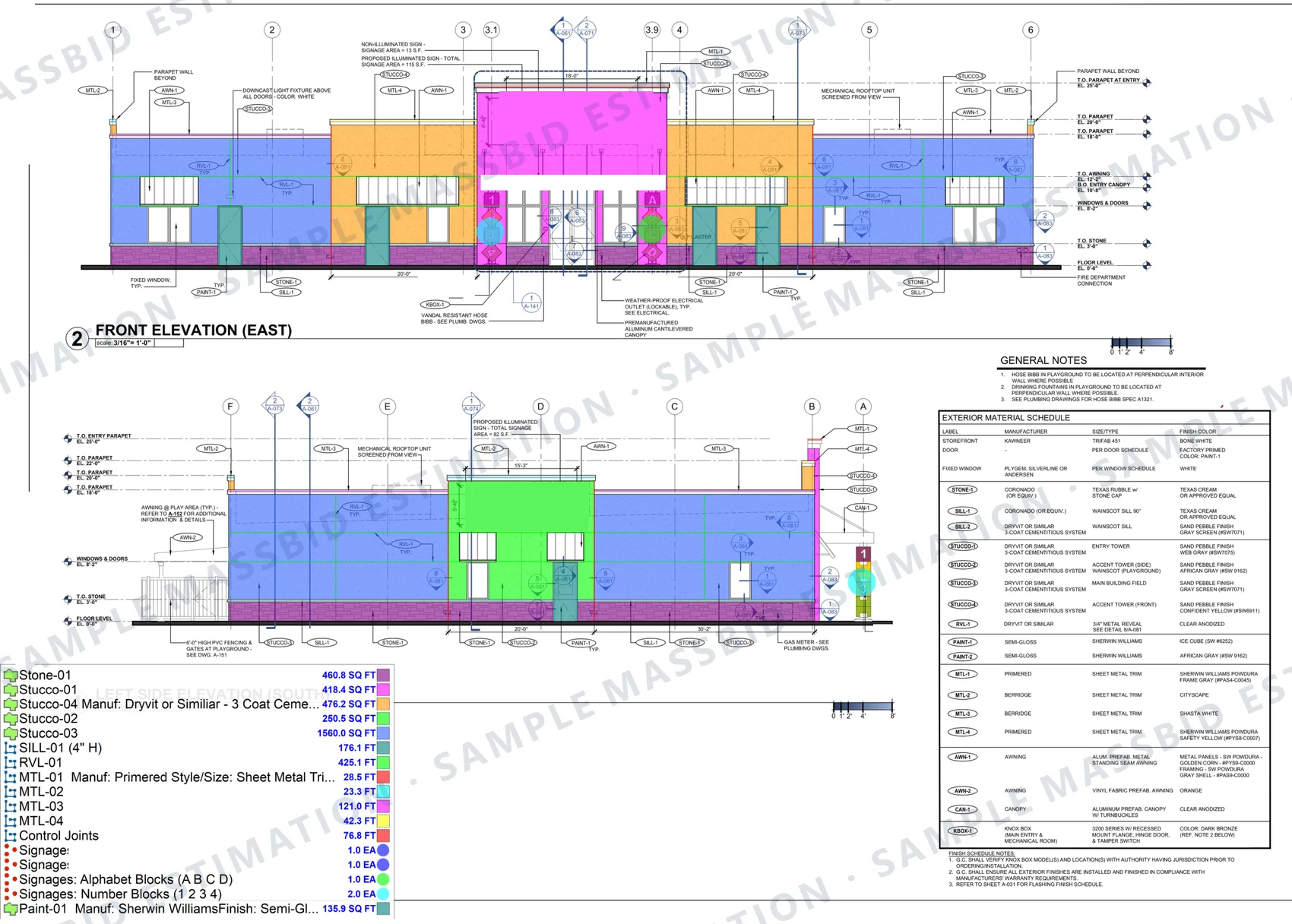
Pages from finished general-contractor packages: a retail store renovation in North Carolina and a new commercial building in Texas. Client names, addresses and title blocks are removed; the quantities are as delivered. Click any page to enlarge.
Building envelope
Exterior envelope takeoff: stucco, stone, trim and control joints
Protects you fromOne exterior number that hides four different systems.
Interior finishes
Ceiling and paint takeoff from a reflected ceiling plan
Protects you fromPainting an open ceiling at the price of a flat one.
Concrete
Concrete pad, thickened edge and bollard takeoff
Protects you fromSite concrete that no subcontractor included.
Priced estimate
Detailed GC estimate with labor and material for every line
Protects you fromA division total you cannot explain at buyout.
Every estimate is built to the client's own specification, so yours may be laid out differently. To see a past project in your own trade, ask for an example. Examples are finished work for other projects, not an estimate of yours; for pricing on your own job, send the bid set for a free quote.
A real bid, by division
GC estimate breakdown by CSI division
Division costs from one finished GC estimate: the renovation of a large retail store in North Carolina, covering every trade except mechanical, electrical and plumbing.
Trade cost came to $325,073 across 13 divisions, before overhead and profit. Finishes was the largest division, followed by thermal and moisture protection and metals, and general requirements alone were close to 15 percent of the total.
Figures are from the delivered estimate, rounded to the dollar. They are specific to that project and are shown to illustrate how a GC estimate is broken down, not as a price guide.
Real jobs, not a price list. Each figure comes from one project, priced for its own ZIP code and that client's wages, overhead and profit. Prices change by region and over time. Yours will be priced for your location.
| Division | Main items | Cost |
|---|---|---|
| 01 General requirements | Supervision, temporary facilities, cleanup | $47,998 |
| 02 Demolition | Selective demolition and relocation | $22,948 |
| 03 Concrete | Pad footings, slab, precast lintel | $5,325 |
| 04 Masonry | Masonry restoration | $3,905 |
| 05 Metals | Canopy, room framing, shade framing, awning | $50,852 |
| 06 Wood and plastics | Finish carpentry and casework | $13,650 |
| 07 Thermal and moisture | Insulation, standing seam roof, exterior finishes | $52,478 |
| 08 Openings | Storefront, specialty and metal doors, hardware | $13,155 |
| 09 Finishes | Drywall, flooring, paint, FRP, ceilings | $84,317 |
| 10 Specialties | Signage, fitting room, accessories | $8,849 |
| 11 Equipment | Owner equipment installation | $2,738 |
| 12 Furnishings | Countertop and sunshade fabric | $3,424 |
| 32 Exterior improvements | Concrete pad, marking, site furnishings, fencing | $15,435 |
| Total trade cost | 13 divisions | $325,073 |
Building somewhere else? See figures from jobs in Texas, California, Florida and other service areas.
Full sample
Read a full sample, page by page
General contractor estimate, from a finished job: a restaurant fit-out, 1,375 sq ft in Texas. Open it full screen, scroll through all 8 pages and zoom in on any line.
This is one real job, shown as an example. It was built to that client's own specification: their wage rates, labor style, type of pricing, and overhead and profit. Prices also change by region and over time, so yours will be priced for your location.
Want a current sample in your own trade or specialty, or have a question? Use the contact form, email [email protected] or call (832) 356-4237.
Who it is for
GC estimating for contractors, construction managers and developers
General contractors
A complete multi-trade estimate for hard-bid work, so you can level sub quotes and cover every division on bid day.
Commercial estimatingConstruction managers
Budgets and bid packages by trade through preconstruction, with quantities you can hand to bidders for a like-for-like comparison.
Preliminary estimatingDesign-build firms
Estimates that track the design as it develops, from concept budget to a priced set of construction documents.
BIM estimatingDevelopers and owners
An independent estimate to test a contractor's number, or a budget by division before you go to bid.
Residential estimating
Project types we prepare GC estimates for
- Ground-up commercial buildings
- Retail renovations and rollouts
- Tenant improvements
- Restaurants
- Medical and clinic work
- Schools and public buildings
- Multi-family housing
- Custom homes and additions
- Light industrial and warehouses
Pricing data
Where the prices come from
Quantities are priced from our own pricing database, built with local vendors across the United States. The estimator enters the project's ZIP code and gets current material prices for that market.
Material prices change from region to region and from month to month, so a price book or a national average is out of date before the bid goes in.
Priced by ZIP code
Current local material prices for the place the job is built, not a national average.
Updated by vendors
Local vendors update their prices in the database as they change.
Labor as you bid it
Union, open shop, or Davis-Bacon and prevailing wage rates with fringes.
How it works
From bid set to a complete GC estimate
Send the bid set
Drawings, the project manual, addenda and the bid form, your markup rates, and your own template or cost codes if you have them.
Free quote
We review the set and reply with a quote and a delivery date, usually within about 20 minutes.
Takeoff, pricing and two QA reviews
Estimators measure and price each trade. A separate QA team checks the quantities, then checks the priced estimate against the specifications and your notes.
Delivery, addenda and revisions
The package typically arrives within 24 to 48 hours. Addenda and revisions are free, with no limit and no time limit, and are handled on priority.
The work is done in-house by more than 20 estimators, typically with 7 to 10 years of industry experience.
What it costs
GC estimating prices
- Single trade
- From $199. Simple scopes typically run $100 to $250.
- Multi-trade GC package
- Typically $200 to $500. Large or complex bid packages are quoted individually.
- Monthly plan
- From $1,499 for 10 to 15 projects, for contractors who bid every week.
Every job is quoted individually from the drawings, and the quote is free. See all pricing
After delivery
An editable Excel workbook and free revisions
- Formulas built in
An Excel workbook you can change yourself
The estimate arrives as an editable Excel workbook with the formulas built in. Change a quantity, a rate or a markup and every total follows. Move overhead and profit from 25% to 30% and the whole bid recalculates on the spot.
- No waiting
Adjust your bid at the last minute
If something changes just before the deadline, you do not have to send the estimate back and wait. Open the workbook, change the number and submit. The control stays with you.
- Priority turnaround
Free revisions, with no limit
Addenda, scope changes and pricing updates are all free, however many times you come back, and there is no time limit. Revisions are handled on priority and typically come back within an hour to a few hours.
Questions
GC estimating FAQ
It is the takeoff and pricing of every trade on a project, assembled into one bid. Quantities are measured for each CSI division, labor and material costs are applied, general conditions are priced, and overhead, profit and other markups are added to reach a bid total. MassBid prepares these packages for general contractors, construction managers and design-build firms.
Whatever the bid calls for, built to your specification. A typical package is a priced workbook with a summary by CSI division and a line-by-line detail sheet, a material list, marked-up plans with each scope color-keyed to its quantity, and a bid summary with overhead, profit, insurance, contingency and tax applied at the rates you set.
A single trade starts at $199. Standard multi-trade projects typically run $200 to $500, and large or complex bid packages are quoted individually from the drawings. The quote is free and usually comes back in about 20 minutes.
Most GC estimates are delivered within 24 to 48 hours of receiving the bid set. Very large plan sets are given a delivery date with the quote, agreed before work begins.
Yes, and many general contractors order it for that reason. With your own quantities and a price for each trade, you can compare sub quotes line against line, see which ones left scope out, and carry a real number for any trade that drew no quote.
Yes. General conditions and general requirements are priced as their own line items. Overhead, profit, insurance, contingency and tax are applied at the percentages you give us and shown separately, so you can change them without touching the trade costs.
Yes. The scope is yours to set. Some contractors order every division; others exclude mechanical, electrical and plumbing because those trades are design-build, or order only the trades they self-perform.
Yes. This page shows a full sample from a finished job (general contractor estimate, for a restaurant fit-out, 1,375 sq ft in Texas), which you can open full screen and read page by page. It was built to that client's own specification, so the wage rates, pricing and overhead and profit are theirs. Ask us for a current sample in your own trade.
From our own pricing database, built with local vendors across the United States. An estimator enters the project's ZIP code and gets current material prices for that market, and vendors update their prices as they change. Labor is priced as union or open shop, or at Davis-Bacon rates with fringes on government work.
Yes. The estimate is delivered as an editable Excel workbook with the formulas built in. Change any quantity, rate or markup and the whole estimate recalculates. If overhead and profit was set at 25% and you want 30%, change that one cell and every total updates, so you can adjust your number minutes before the bid is due without sending it back to us.
As many as you need. Every revision is free, including addenda, scope changes and pricing updates, however many times you come back, and there is no time limit. Revisions are handled on priority and are typically returned within an hour to a few hours, depending on the size of the change.
Yes. Every estimate is built to the client's own specification. Send the bid form, schedule of values or your own template and the package is returned in that format, with alternates and unit prices broken out where the documents ask for them.
Because bid volume is uneven and a full estimating department is expensive to carry through a slow quarter. Outsourcing gives a contractor a checked, division-by-division estimate in a day or two, lets an in-house estimator review several bids instead of producing one, and costs nothing when there is nothing to bid.
Related services and service areas
Have a bid due? Send the set.
Free quote in about 20 minutes. A complete multi-trade estimate typically in 24 to 48 hours, built to your bid format, with free addenda and unlimited free revisions. Based in Houston and preparing GC estimates in all 50 states.