For roofing contractors
Roofing estimating and takeoff services
Roof area by system and pitch, every foot of flashing, coping and edge metal, and every drain, scupper and curb, taken off the roof plan and priced.
- Area by pitch and system
- Flashing and edge metal measured
- 24 to 48 hours
In short
What roofing estimating covers
Roofing estimating is the takeoff and pricing of a roof system from the drawings: the membrane, shingles or metal panels, the insulation and underlayment beneath, and the flashing, coping, edge metal, drains, gutters and downspouts around it. Roof area is measured by slope and system, and every edge and penetration is measured or counted. MassBid Estimation prepares roofing takeoffs and estimates for roofing contractors, general contractors and suppliers, typically in 24 to 48 hours.
- Systems
- EPDM, TPO and other membranes, asphalt shingles, standing seam and metal panels
- CSI division
- 07 Thermal and Moisture Protection: 07 30, 07 40, 07 50, 07 60, 07 70
- You send
- Roof plan, details and sections, exterior elevations, the Division 07 spec and addenda
- You get
- Marked-up roof plans, a priced workbook with labor per line, and a material list
- Turnaround
- 24 to 48 hours on most projects
- Checked by
- A separate QA team, twice on every job
- Coverage
- All 50 states, priced to the project's ZIP code
- Quote
- Free, usually back in about 20 minutes
Tuesday · 6:30 PM
You were on a roof all day. The GC wants your number by morning, and the drawings came through at four.
The field of a roof is the easy part to measure: length times width, adjusted for slope. Almost nobody loses money there. Roofing bids go wrong at the edges and the penetrations, where the material is expensive, the labor is slow and the drawings say the least.
Parapet flashing height, coping width, how many drains, whether the curbs are by the roofer or the mechanical contractor, what is under the membrane. A takeoff done in a hurry prices the squares and covers the rest with a percentage.
Four ways a roofing bid loses money
01 · The edges
Flashing and edge metal covered by a percentage
Counter flashing, membrane flashing at parapets, coping, gravel stop and drip edge are each a different product and a different labor rate. An allowance treats them as one.
What changes
Every flashing and edge condition is measured in feet on its own line, with its height or width.
02 · The pitch
Plan area priced as roof area
A roof measured in plan view is smaller than the roof you buy shingles for. The steeper the pitch, the bigger the gap, and steep slopes cost more to work on.
What changes
Area is taken off by pitch, so each slope is adjusted and priced at its own rate.
03 · The build-up
Insulation, cover board and underlayment left off
What sits under the membrane is often called out only in a note or a detail. On a low-slope roof it can cost more than the membrane itself.
What changes
Each layer of the roof assembly is its own line, and anything not shown is flagged as an assumption.
04 · The penetrations
Drains, scuppers, curbs and vents nobody counted
Every penetration is flashing, labor and a place for a leak. They are scattered over the roof, mechanical and plumbing plans.
What changes
Drains, scuppers, curbs and vents are counted from the roof plan and checked against the mechanical and plumbing sheets.
Then and now
What has changed in roofing estimating
A roof used to be estimated from a tape, a pitch gauge and a price per square. Four things have changed that.
Roofs are measured from drawings and imagery
New work is taken off the roof plan on screen; reroofs are often measured from aerial imagery. Either way the measurement can be shown, not just stated.
Insulation requirements went up
Energy codes have raised the insulation required on low-slope roofs. Thicker boards, tapered systems and cover boards have made the build-up a larger share of the job.
Material prices move
Membrane, insulation and metal prices have been volatile in recent years, and suppliers hold quotes for a short time. Quantities have to stand apart from prices.
Wind and warranty rules shape the detail
Edge metal, fastening patterns and manufacturer warranty requirements dictate details that used to be left to the installer. They change both quantity and labor.
Real roofing work
Sample roofing takeoffs and estimates
Pages from finished jobs: a low-slope commercial roof in Oklahoma, a shingled duplex in New York and a two-story house. Client names, brand names and title blocks are removed; the quantities are as delivered. Click any page to enlarge.
Low-slope roof
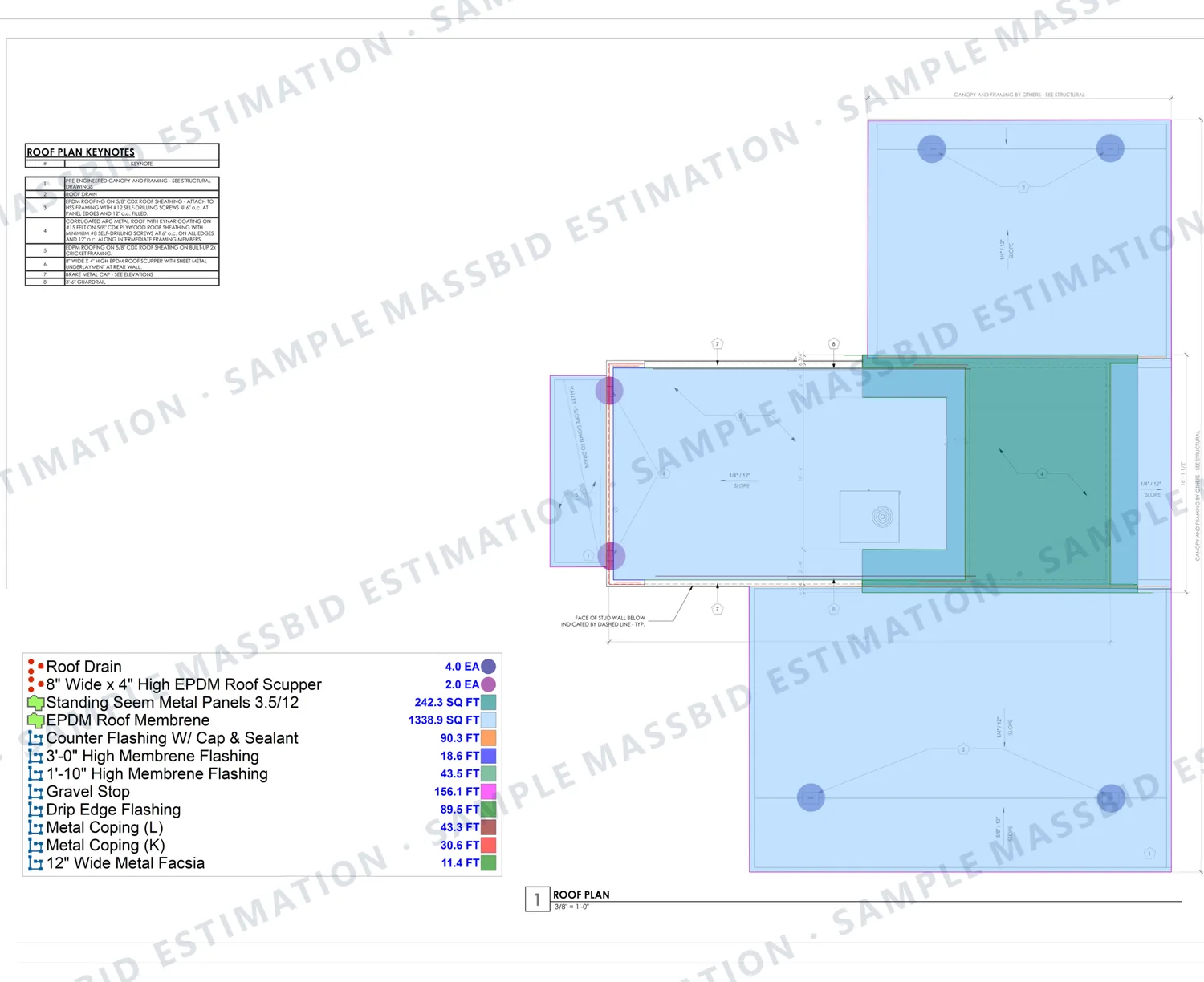
Flat roof takeoff: EPDM membrane, metal panels, coping and flashing
Protects you fromA price per square that ignores the edges.
Steep-slope roof
Asphalt shingle takeoff by pitch, with ridge, valley and gutters
Protects you fromOne pitch factor for a roof with three slopes.
Gutters
Gutter and downspout takeoff from the elevations
Protects you fromDownspout elbows nobody put on the order.
Priced estimate
Priced roofing estimate with assumptions marked on each line
Protects you fromAn assumption buried inside a lump sum.
Every estimate is built to the client's own specification, so yours may be laid out differently. To see a past project in your own trade, ask for an example. Examples are finished work for other projects, not an estimate of yours; for pricing on your own job, send the roof plans for a free quote.
A real roofing estimate
Roofing cost breakdown for a low-slope commercial roof
Line totals from one finished roofing estimate: a small drive-through building in Oklahoma with about 1,590 square feet of roof work.
Division 07 trade cost came to $21,919, or about $13.79 per square foot of roof. The EPDM membrane itself was $4,195, less than a fifth of that. The insulation beneath it cost almost twice as much, and flashing, edge metal and accessories together came to about $5,000. With general requirements and markups the suggested bid was $35,026.
Figures are from the delivered estimate, labor plus material, rounded to the dollar, with related lines combined. They are specific to that project and are shown to illustrate how a roofing estimate is broken down, not as a price guide.
Real jobs, not a price list. Each figure comes from one project, priced for its own ZIP code and that client's wages, overhead and profit. Prices change by region and over time. Yours will be priced for your location.
| Item | Quantity | Cost |
|---|---|---|
| 4-inch rigid insulation | 1,338 SF | $7,580 |
| 60 mil EPDM membrane | 1,338 SF | $4,195 |
| 1/2-inch roof cover board | 1,339 SF | $2,872 |
| Standing seam metal panels | 252 SF | $2,134 |
| Metal fascia | 82 LF | $957 |
| Coping and brake metal cap | 75 LF | $647 |
| Drip edge | 156 LF | $575 |
| Insulated roof curb | 15 LF | $539 |
| Roof scuppers | 2 EA | $459 |
| Gravel stop | 90 LF | $458 |
| EPDM flashing at drains, curb, scuppers and parapet | 115 LF | $435 |
| Counter flashing with cap | 90 LF | $382 |
| Wood blocking and cant strip | 86 LF | $285 |
| Felt underlayment at metal panels | 252 SF | $208 |
| Joint sealant | 112 LF | $160 |
| Flashing at vent through roof | 1 EA | $34 |
| Division 07 trade cost | $21,919 |
Building somewhere else? See figures from jobs in Texas, California, Florida and other service areas.
Full sample
Read a full sample, page by page
Roofing and sheet metal, from a finished job: a drive-through building in Oklahoma. Open it full screen, scroll through all 3 pages and zoom in on any line.
This is one real job, shown as an example. It was built to that client's own specification: their wage rates, labor style, type of pricing, and overhead and profit. Prices also change by region and over time, so yours will be priced for your location.
Want a current sample in your own trade or specialty, or have a question? Use the contact form, email [email protected] or call (832) 356-4237.
Who it is for
Roofing estimating for roofers, general contractors and suppliers
Roofing contractors
A measured, priced estimate for each bid, with your trade isolated from the full drawing set and returned in the format the GC asked for.
Commercial estimatingResidential roofers
Shingle roofs by pitch with ridge, hip, valley, eave, underlayment, flashing and gutters, ready to order from.
Residential estimatingGeneral contractors
An independent Division 07 number to check a roofing quote, or to carry when none comes in.
GC estimatingRoofing suppliers
Quantities only: squares by system, insulation, flashing and edge metal in feet, limited to what you sell.
Supplier takeoffs
Roofing scopes we take off
- EPDM and TPO membrane
- Asphalt shingles
- Standing seam metal roofing
- Roof insulation and cover board
- Underlayment
- Flashing and counter flashing
- Coping and edge metal
- Roof drains and scuppers
- Roof curbs and penetrations
- Gutters and downspouts
- Soffit and fascia
- Roof demolition and tear-off
Pricing data
Where the prices come from
Quantities are priced from our own pricing database, built with local vendors across the United States. The estimator enters the project's ZIP code and gets current material prices for that market.
Material prices change from region to region and from month to month, so a price book or a national average is out of date before the bid goes in.
Priced by ZIP code
Current local material prices for the place the job is built, not a national average.
Updated by vendors
Local vendors update their prices in the database as they change.
Labor as you bid it
Union, open shop, or Davis-Bacon and prevailing wage rates with fringes.
How it works
From roof plans to a finished estimate
Send the drawings
Roof plan, roof details and sections, exterior elevations, the Division 07 specification and addenda, plus your own template or pricing.
Free quote
We review the set and reply with a quote and a delivery date, usually within about 20 minutes.
Measure, count, price and two QA reviews
Roof area is measured by system and pitch; edges, flashing and penetrations are measured or counted. A separate QA team checks the quantities, then the priced estimate.
Delivery and revisions
The package typically arrives within 24 to 48 hours. Updates when the specifications change are free, with no limit and no time limit.
The work is done in-house by more than 20 estimators, typically with 7 to 10 years of industry experience.
What it costs
Roofing estimating prices
- Single roof
- From $199. Simple scopes typically run $100 to $250.
- Larger buildings
- Typically $200 to $500. Large or complex roofs are quoted individually.
- Monthly plan
- From $1,499 for 10 to 15 projects, for roofing contractors who bid every week.
Every job is quoted individually from the drawings, and the quote is free. See all pricing
After delivery
An editable Excel workbook and free revisions
- Formulas built in
An Excel workbook you can change yourself
The estimate arrives as an editable Excel workbook with the formulas built in. Change a quantity, a rate or a markup and every total follows. Move overhead and profit from 25% to 30% and the whole bid recalculates on the spot.
- No waiting
Adjust your bid at the last minute
If something changes just before the deadline, you do not have to send the estimate back and wait. Open the workbook, change the number and submit. The control stays with you.
- Priority turnaround
Free revisions, with no limit
Addenda, scope changes and pricing updates are all free, however many times you come back, and there is no time limit. Revisions are handled on priority and typically come back within an hour to a few hours.
Questions
Roofing estimating FAQ
It is the takeoff and pricing of a roof system from the drawings. Roof area is measured by system and pitch, insulation and underlayment are added, flashing, coping and edge metal are measured in feet, drains, scuppers and curbs are counted, and labor and material prices are applied to produce an estimate a roofing contractor can bid from.
The roof covering by area, the insulation, cover board and underlayment beneath it, every flashing and edge condition by length, ridge, hip and valley on sloped roofs, drains, scuppers, curbs and vents by count, and gutters, downspouts, soffit and fascia where they are part of the scope.
Area is taken off separately for each pitch and adjusted for slope, so the quantity is the roof surface and not the plan area. On one duplex we took off, the shingles were split into three pitches: 5:12, 2.5:12 and 7:12.
Yes. Low-slope membrane roofs such as EPDM and TPO, asphalt shingle roofs and standing seam metal roofs are all taken off, including buildings that combine them.
The item is priced on a stated assumption and marked as assumed on its own line, so you can see it and change it. Nothing is assumed silently.
It depends on the system and the amount of edge and penetration work. On one small low-slope roof we estimated, Division 07 trade cost was about $13.79 per square foot of roof before general requirements and markups. Small roofs carry more edge per square foot and cost more than large ones.
A single roof starts at $199, and simple scopes typically run $100 to $250. Larger buildings typically run $200 to $500, and large or complex roofs are quoted individually. The quote is free and usually comes back in about 20 minutes.
Yes. This page shows a full sample from a finished job (roofing and sheet metal, for a drive-through building in Oklahoma), which you can open full screen and read page by page. It was built to that client's own specification, so the wage rates, pricing and overhead and profit are theirs. Ask us for a current sample in your own trade.
From our own pricing database, built with local vendors across the United States. An estimator enters the project's ZIP code and gets current material prices for that market, and vendors update their prices as they change. Labor is priced as union or open shop, or at Davis-Bacon rates with fringes on government work.
Yes. The estimate is delivered as an editable Excel workbook with the formulas built in. Change any quantity, rate or markup and the whole estimate recalculates. If overhead and profit was set at 25% and you want 30%, change that one cell and every total updates, so you can adjust your number minutes before the bid is due without sending it back to us.
As many as you need. Every revision is free, including addenda, scope changes and pricing updates, however many times you come back, and there is no time limit. Revisions are handled on priority and are typically returned within an hour to a few hours, depending on the size of the change.
Yes. Every estimate is built to the client's own specification. Send the general contractor's bid form or your own template and the roofing scope is broken out and returned in that format.
Because a roofer's day is spent on roofs, and the takeoff is usually due the next morning. Outsourcing gives a roofing contractor a measured, checked estimate in a day or two without giving up evenings to it.
Related services and service areas
Have a roof to bid? Send the plans.
Free quote in about 20 minutes. Roofing takeoffs and estimates typically in 24 to 48 hours, built to your format, with free revisions with no limit. Based in Houston and estimating roofing in all 50 states.