For mechanical, electrical and plumbing contractors
MEP estimating services: HVAC, electrical and plumbing
Every duct run, pipe, fitting, fixture and device counted by size from the drawings and priced, so your number is built on the system as drawn and not on a cost per square foot.
- Counted by size and type
- Two QA reviews on every job
- 24 to 48 hours
In short
What MEP estimating covers
MEP estimating is the takeoff and pricing of a building's mechanical, electrical and plumbing systems: ductwork, piping, equipment, fixtures, devices, conduit and wire. MassBid Estimation prepares HVAC, electrical and plumbing takeoffs and cost estimates for MEP subcontractors, general contractors and suppliers, counted by size and type from the drawings, built to each client's format and typically delivered in 24 to 48 hours.
- Trades
- HVAC and mechanical, electrical, plumbing, low voltage, fire alarm
- CSI divisions
- 22 Plumbing, 23 HVAC, 26 Electrical, 27 Communications, 28 Electronic safety
- You send
- MEP drawings, schedules and specifications, addenda, and your own template if you have one
- You get
- Marked-up plans, a priced workbook with labor and material per line, and a material list
- Turnaround
- 24 to 48 hours on most projects
- Checked by
- A separate QA team, twice on every job
- Coverage
- All 50 states, priced to the project's ZIP code
- Quote
- Free, usually back in about 20 minutes
Bid day · 11:30 AM
The GC wants your number by two. The plumbing set is fourteen sheets, and the fitting count is still a guess.
MEP work is the hardest part of a building to price quickly. The cost is not in the big items anyone can see. It is in the fittings, hangers, insulation, boxes and terminations that only appear when someone traces every run on every sheet.
With hours to go, most subcontractors count the equipment and fixtures, measure the main runs and cover the rest with a factor. When the factor is right the job makes money. When the building has more risers, longer branches or tighter ceilings than the last one, it does not.
Four ways an MEP bid loses money
01 · The fittings
Pipe measured, fittings guessed
Elbows, tees, reducers and couplings are covered with a percentage. On a job with many short branches the percentage is far too low, and the difference is all labor.
What changes
Fittings are counted by type and size on the plans, each on its own line.
02 · The risers
What the floor plan does not show
Vertical runs between floors, drops to fixtures and offsets around structure add length that a plan-view measurement misses entirely.
What changes
Riser diagrams and sections are read alongside the plans, and vertical runs are added to the takeoff.
03 · The schedules
A fixture schedule that disagrees with the plan
The schedule lists twelve of a fixture and the plans show seventeen. Whoever prices from the schedule alone is short before the job starts.
What changes
Fixtures, devices and equipment are counted on the plans and checked against the schedules; differences are flagged.
04 · The scope line
“By others” on one sheet, yours on another
Controls wiring, equipment connections, condensate drains and fire-stopping sit on the line between trades. Each set of drawings points at the other.
What changes
Items on the boundary are listed separately and marked as included, excluded or assumed.
Then and now
What has changed in MEP estimating
Mechanical and electrical work used to be priced from a counter, a scale wheel and a labor-unit manual. Four things have changed how it has to be done.
Equipment lead times drive the bid
Switchgear, panels, rooftop units and other major equipment can carry long lead times and prices that hold only briefly. Equipment has to be scheduled and quoted separately from the commodity material.
Commodity prices move
Copper, steel pipe and sheet metal have been volatile in recent years. An estimate that keeps quantities apart from unit prices can be repriced in minutes when the market shifts.
Systems are denser
Energy codes, controls, low-voltage systems and ventilation requirements have added devices and runs to every floor. A square-foot figure from an older building understates today's scope.
The count is done on screen
Fixtures and fittings are counted digitally and, on some jobs, quantities come from a coordinated model. Done properly, each line points back to a colored mark on a sheet.
Real MEP work
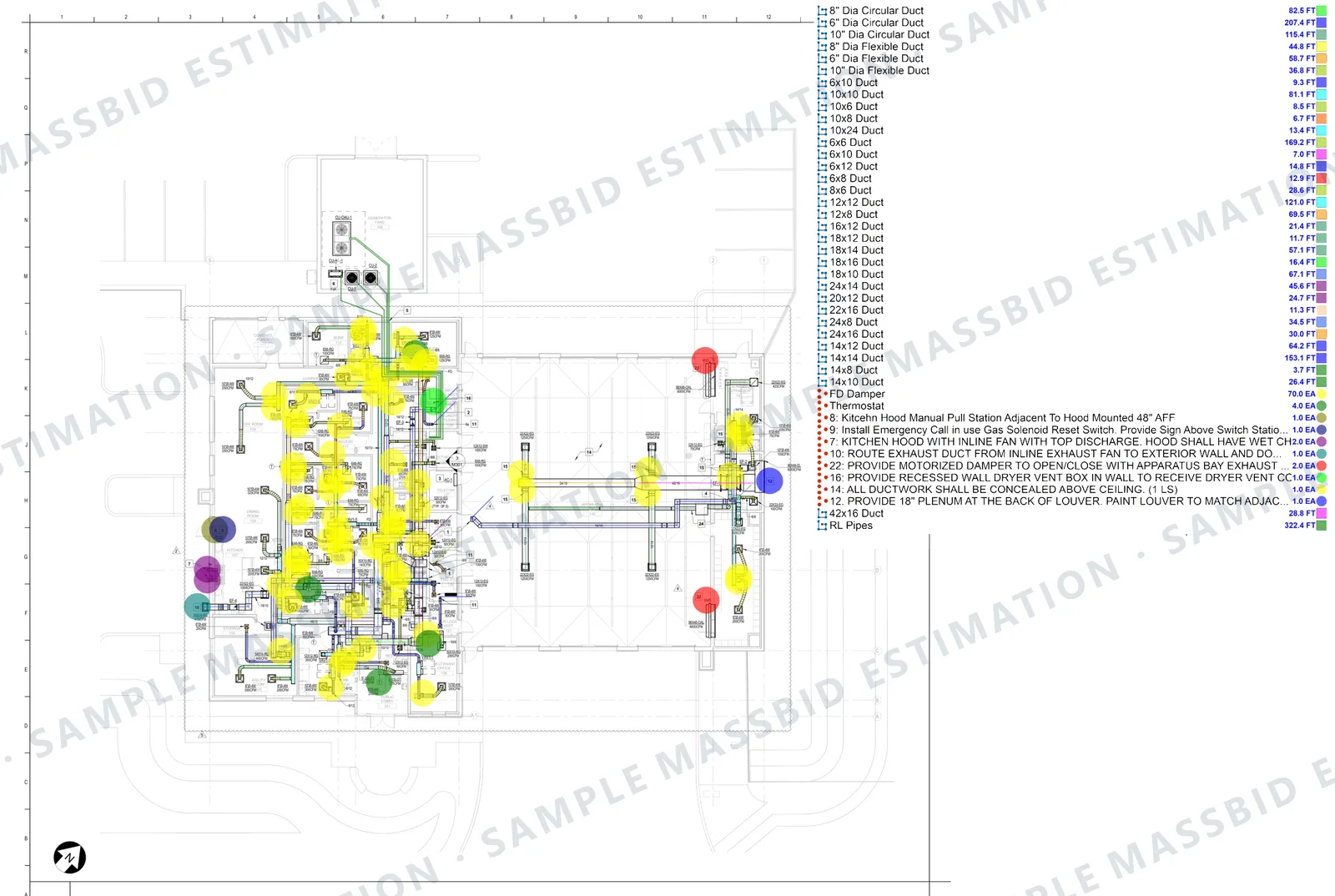
Sample HVAC, electrical and plumbing takeoffs
Pages from finished jobs: a hotel, a fire station and a grocery store, all in Florida. Client names, addresses and title blocks are removed; the quantities are as delivered. Click any page to enlarge.
HVAC ductwork
HVAC ductwork takeoff by duct size
Protects you fromSheet metal priced by the pound from a guessed weight.
Electrical
Electrical lighting takeoff with fixture counts by type
Protects you fromA fixture count that lumps emergency fixtures in with standard ones.
Plumbing piping
Plumbing pipe and fitting takeoff by diameter
Protects you fromFittings covered by a percentage of the pipe.
Priced estimate
Priced plumbing estimate with labor and material for every line
Protects you fromA lump sum you cannot reprice when copper moves.
Every estimate is built to the client's own specification, so yours may be laid out differently. To see a past project in your own trade, ask for an example. Examples are finished work for other projects, not an estimate of yours; for pricing on your own job, send the drawings for a free quote.
Real MEP estimates
MEP cost by trade on real projects
Trade costs from two finished estimates: the plumbing and HVAC for a four-story hotel in Florida of about 80,500 square feet, and the electrical for a grocery store in Florida of about 14,500 square feet.
On the hotel, plumbing came to $10.83 per square foot and HVAC to $9.49, before general requirements, overhead and profit, insurance, contingency and tax. Plumbing cost more than HVAC on this job, as it often does where every guest unit has a bathroom.
Figures are from the delivered estimates. They are specific to those projects and are shown to illustrate how an MEP estimate is broken down, not as a price guide.
Real jobs, not a price list. Each figure comes from one project, priced for its own ZIP code and that client's wages, overhead and profit. Prices change by region and over time. Yours will be priced for your location.
| Trade | Project | Trade cost | Per sq ft |
|---|---|---|---|
| Plumbing (Div. 22) | Four-story hotel, 80,548 sq ft | $872,111 | $10.83 |
| HVAC (Div. 23) | Four-story hotel, 80,548 sq ft | $764,512 | $9.49 |
| Electrical (Div. 26) | Grocery store, 14,536 sq ft | $294,495 | $20.26 |
| Communications (Div. 27) | Grocery store, 14,536 sq ft | $12,896 | $0.89 |
| Fire alarm (Div. 28) | Grocery store, 14,536 sq ft | $3,011 | $0.21 |
Building somewhere else? See figures from jobs in Texas, California, Florida and other service areas.
Full sample
Read a full sample, page by page
Plumbing and HVAC, from a finished job: a fire station, 9,250 sq ft in Florida. Open it full screen, scroll through all 4 pages and zoom in on any line.
This is one real job, shown as an example. It was built to that client's own specification: their wage rates, labor style, type of pricing, and overhead and profit. Prices also change by region and over time, so yours will be priced for your location.
Want a current sample in your own trade or specialty, or have a question? Use the contact form, email [email protected] or call (832) 356-4237.
Who it is for
MEP estimating for subcontractors, general contractors and suppliers
Mechanical and HVAC contractors
Ductwork by size, equipment, air devices, dampers, insulation and refrigerant or hydronic piping, ready to price or to send to your sheet-metal shop.
HVAC estimatingElectrical contractors
Fixtures, devices, panels and gear counted by type, with conduit and wire measured and low-voltage and fire alarm kept separate.
Electrical estimatingPlumbing contractors
Pipe and fittings by system, material and diameter, with fixtures, valves, insulation and below-grade work broken out.
Plumbing estimatingGeneral contractors and suppliers
An independent MEP number to check sub quotes against, or quantities only for a supplier pricing pipe, fittings or fixtures.
GC estimating
MEP scopes we take off
- HVAC ductwork
- Rooftop and split-system equipment
- VRF and refrigerant piping
- Hydronic piping
- Domestic water
- Sanitary, waste and vent
- Storm drainage
- Natural gas piping
- Lighting and power
- Conduit and wire
- Fire alarm
- Low voltage and data
Pricing data
Where the prices come from
Quantities are priced from our own pricing database, built with local vendors across the United States. The estimator enters the project's ZIP code and gets current material prices for that market.
Material prices change from region to region and from month to month, so a price book or a national average is out of date before the bid goes in.
Priced by ZIP code
Current local material prices for the place the job is built, not a national average.
Updated by vendors
Local vendors update their prices in the database as they change.
Labor as you bid it
Union, open shop, or Davis-Bacon and prevailing wage rates with fringes.
How it works
From MEP drawings to a finished estimate
Send the drawings
Mechanical, electrical and plumbing sheets with schedules and specifications, addenda, the trades you want covered, and your own template or labor units.
Free quote
We review the set and reply with a quote and a delivery date, usually within about 20 minutes.
Takeoff, pricing and two QA reviews
Estimators count and measure each system. A separate QA team checks the quantities against the plans and schedules, then checks the priced estimate against your notes.
Delivery, addenda and revisions
The package typically arrives within 24 to 48 hours. Addenda and revisions are free, with no limit and no time limit, and are handled on priority.
The work is done in-house by more than 20 estimators, typically with 7 to 10 years of industry experience.
What it costs
MEP estimating prices
- Single trade
- From $199 for mechanical, electrical or plumbing. Simple scopes typically run $100 to $250.
- All three trades
- Typically $200 to $500. Large or complex MEP packages are quoted individually.
- Monthly plan
- From $1,499 for 10 to 15 projects, for subcontractors who bid every week.
Every job is quoted individually from the drawings, and the quote is free. See all pricing
After delivery
An editable Excel workbook and free revisions
- Formulas built in
An Excel workbook you can change yourself
The estimate arrives as an editable Excel workbook with the formulas built in. Change a quantity, a rate or a markup and every total follows. Move overhead and profit from 25% to 30% and the whole bid recalculates on the spot.
- No waiting
Adjust your bid at the last minute
If something changes just before the deadline, you do not have to send the estimate back and wait. Open the workbook, change the number and submit. The control stays with you.
- Priority turnaround
Free revisions, with no limit
Addenda, scope changes and pricing updates are all free, however many times you come back, and there is no time limit. Revisions are handled on priority and typically come back within an hour to a few hours.
Questions
MEP estimating FAQ
It is the takeoff and pricing of a building's mechanical, electrical and plumbing systems. Ductwork, piping, fittings, fixtures, devices, conduit and wire are counted or measured from the drawings, labor hours and material costs are applied, and the result is an estimate a subcontractor can bid from.
Division 22 Plumbing, Division 23 Heating, Ventilating and Air Conditioning, Division 26 Electrical, Division 27 Communications and Division 28 Electronic Safety and Security. Division 21 Fire Suppression can be included where it is on the drawings.
A single trade starts at $199, and simple scopes typically run $100 to $250. Estimates covering several trades typically run $200 to $500. Large or complex MEP packages are quoted individually from the drawings. The quote is free and usually comes back in about 20 minutes.
Most MEP takeoffs and estimates are delivered within 24 to 48 hours of receiving the drawings. Very large sets are given a delivery date with the quote, agreed before work begins.
Fittings are counted. Elbows, tees, wyes, reducers and couplings are listed by type and size on their own lines, alongside the pipe or duct they belong to. On most jobs the fittings carry a large share of the labor, which is why they are not covered by a percentage.
Yes. Most MEP subcontractors order only their own trade: HVAC, electrical or plumbing. A general contractor can order all three as one package.
Yes. Every estimate is built to the client's own specification. Send your labor units, material pricing or a sample of a past estimate and the package is returned in that format. You can also order quantities only and price them yourself.
Yes. This page shows a full sample from a finished job (plumbing and HVAC, for a fire station, 9,250 sq ft in Florida), which you can open full screen and read page by page. It was built to that client's own specification, so the wage rates, pricing and overhead and profit are theirs. Ask us for a current sample in your own trade.
From our own pricing database, built with local vendors across the United States. An estimator enters the project's ZIP code and gets current material prices for that market, and vendors update their prices as they change. Labor is priced as union or open shop, or at Davis-Bacon rates with fringes on government work.
Yes. The estimate is delivered as an editable Excel workbook with the formulas built in. Change any quantity, rate or markup and the whole estimate recalculates. If overhead and profit was set at 25% and you want 30%, change that one cell and every total updates, so you can adjust your number minutes before the bid is due without sending it back to us.
As many as you need. Every revision is free, including addenda, scope changes and pricing updates, however many times you come back, and there is no time limit. Revisions are handled on priority and are typically returned within an hour to a few hours, depending on the size of the change.
Where the drawings are incomplete, the estimate is prepared from what is shown, and anything assumed is listed as an assumption with its basis. A takeoff cannot be prepared with no drawings at all.
Because MEP takeoff is slow, detailed work that a busy contractor rarely has hours for in bid week. Outsourcing gives a subcontractor a counted, checked estimate in a day or two, lets them bid more jobs with the same staff, and costs nothing in a week with no bids.
Have an MEP bid due? Send the drawings.
Free quote in about 20 minutes. HVAC, electrical and plumbing takeoffs typically in 24 to 48 hours, built to your format, with free addenda and unlimited free revisions. Based in Houston and estimating MEP work in all 50 states.