For building-material suppliers and lumber dealers
Building wrap, sill sealer and panel adhesive takeoffs
Wall area, plate length and floor area measured on the drawings and converted to the rolls and tubes you sell, building by building.
- Rolls and tubes, not square feet
- By building and floor
- 24 to 48 hours
In short
What this takeoff gives you
A building wrap, sill sealer and panel adhesive takeoff is a quantity list of the roll and tube goods a framing package needs, in the units a supplier sells: rolls of housewrap by wall area, rolls of seam and flashing tape, rolls of sill sealer by wall width, and tubes of subfloor adhesive by floor area. MassBid Estimation prepares it for building-material suppliers and dealers with each quantity measured on the drawings and converted by a stated rule, typically in 24 to 48 hours.
- Covers
- Housewrap, seam and flashing tape, sill sealer, panel adhesive, flex wrap, corner tape, sealant
- Method
- Area or length measured on the drawings, then divided by roll or tube coverage with waste stated
- You send
- Plans, elevations, wall sections, your scope sheet, default products and roll sizes
- You get
- A quantity workbook by building plus color-keyed plan and elevation sheets, one item per page
- Turnaround
- 24 to 48 hours on most projects
- Revisions
- Addenda and revisions handled free, with no limit
- Built for
- Suppliers of housewrap, tapes, sill sealer, adhesives and framing packages
- Quote
- Free, usually back in about 20 minutes
Friday · 11:10 AM
The framer wants the wrap, the sealer and the glue on the first truck. The plans give square feet. You sell rolls.
Roll and tube goods are the cheapest lines on a framing package and the ones that stop a crew when they run out. Nobody draws them. Housewrap is a note on the elevation, sill sealer is a line in a wall section, and subfloor adhesive is a sentence in the structural notes.
Turning that into an order means measuring the wall, the plate and the floor, then dividing by what a roll or a tube covers. Do it by eye and the job is short on the third floor.
Four ways a roll-goods takeoff goes wrong
01 · The wall
Housewrap figured from the floor plan
Wrap covers the wall, including gables and returns the plan does not show.
What changes
Wall area is shaded on the elevations and converted to rolls at the roll size you stock.
02 · The plate
Sill sealer in one width
Exterior walls can be two different thicknesses, and the sealer is sold by width.
What changes
Plate length is measured by wall width, and each width is its own line in rolls.
03 · The floors
Adhesive counted for one floor
Subfloor adhesive goes on every framed floor, not the slab, and the coverage per tube is in the product data.
What changes
Floor area is measured per level and converted to tubes, with each floor on its own line.
04 · The tape
Seam and flashing tape guessed
Seam tape follows the wrap, flashing tape follows the metal flashings and the corners, and each comes in a different width.
What changes
Each tape is tied to what it covers and listed by width and roll length.
Then and now
How the quantities are built
Every line starts as something measured on a drawing and ends in the unit you sell. Four examples from one three-story apartment building.
Wall area to rolls of wrap
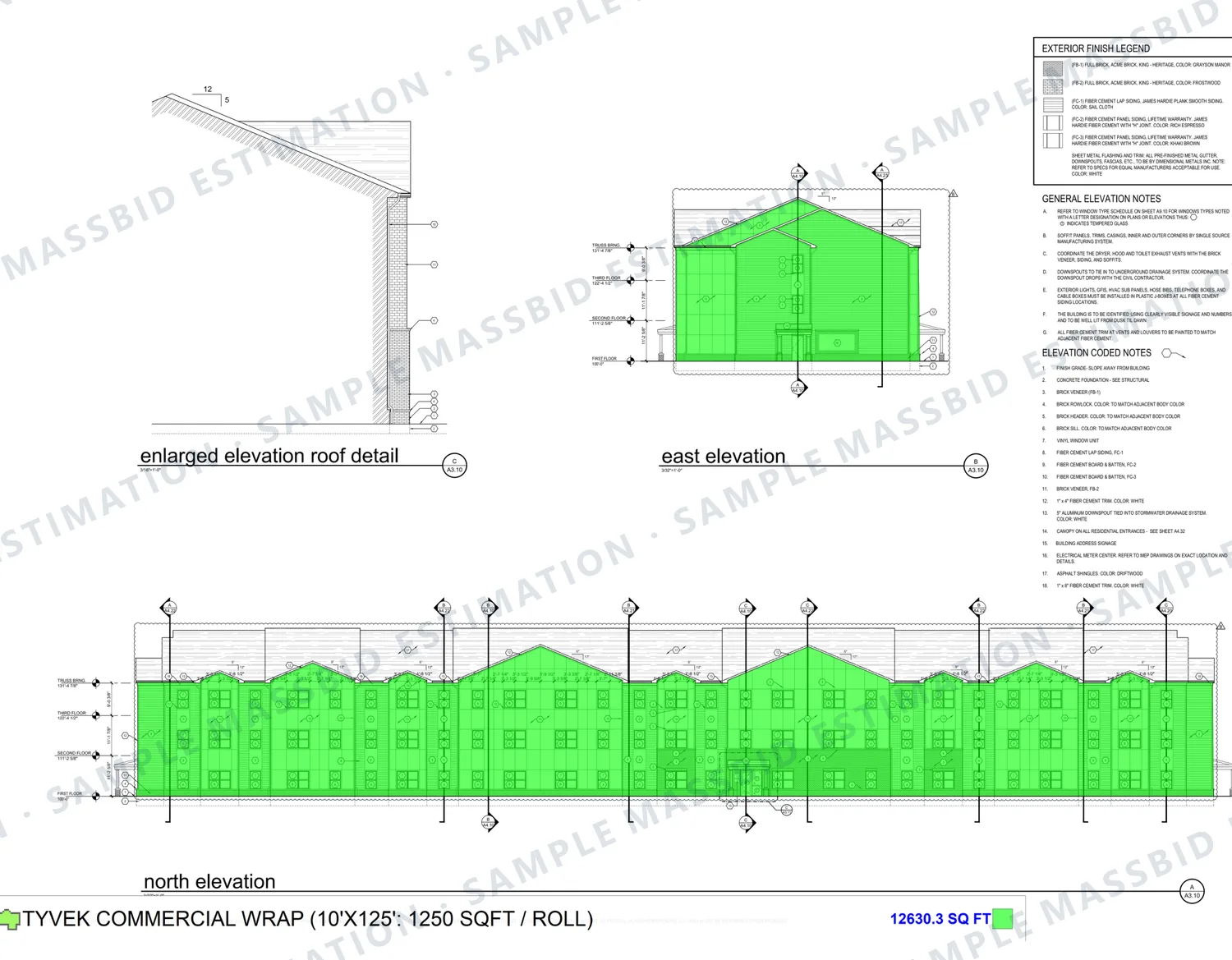
Wall area is shaded on each elevation; one sheet read 12,636 sq ft. The building total is divided by 1,250 sq ft per roll, giving 25.7 rolls with waste.
Plate length to rolls of sill sealer
888.2 ft of 5.5-inch plate on the first-floor plan, divided by 25 ft per roll, is 35.6 rolls.
Floor area to tubes of adhesive
18,502.7 sq ft on each framed floor converts to 212 tubes of 29 oz adhesive per floor, 424 for the two floors above the slab.
Corners to rolls of tape
76 exterior corners at 31 ft 5 in high are counted on the plan and converted to 34.9 rolls of 12-inch by 75 ft corner tape.
On real drawings
Sample building wrap and sill sealer takeoff pages
Pages from one finished job: a three-story apartment building in Texas with 160 windows. Customer, project name and location are withheld; the quantities are as delivered. Click any page to enlarge.
Building wrap
Building wrap measured as wall area on the elevations
Protects you fromWrap ordered from the floor area.
Panel adhesive
Panel adhesive measured as floor area, level by level
Protects you fromAdhesive for one floor of two.
Sill sealer
Sill sealer traced along the first-floor plates
Protects you fromSealer short by the corridor walls.
Openings
Windows counted by cladding, to drive tape and flex wrap
Protects you fromOne tape width for every opening.
Materials list
Materials list in rolls, tubes and pieces
Protects you fromSquare feet your counter has to convert.
Every estimate is built to the client's own specification, so yours may be laid out differently. To see a past project in your own trade, ask for an example. Examples are finished work for other projects, not an estimate of yours; for pricing on your own job, send the plans for a free quote.
Check the arithmetic
From the drawing to the roll count
Rows from the delivered workbook for a three-story apartment building in Texas. Each quantity can be followed from a figure printed on a marked-up sheet.
Items the drawings did not show, such as flex wrap per unit, are marked ASSUMED on the list with the rule used, so they can be changed in one step.
Quantities include the waste factor from the supplier's template and keep fractions so the arithmetic stays visible; round up to whole rolls when you ship.
| Product | Measured from | Quantity |
|---|---|---|
| Commercial building wrap, 10 x 125 ft | Wall area on the elevations | 25.7 rolls |
| 3 in x 165 ft seam tape | Wrap seams | 52 rolls |
| 5.5 in sill sealer, 25 ft roll | 888.2 ft of plate | 35.6 rolls |
| Panel adhesive, 29 oz | 18,502.7 sq ft on each of two floors | 424 tubes |
| 12 in x 75 ft corner flashing tape | 76 corners at 31 ft 5 in | 34.9 rolls |
| 4 in x 75 ft flashing tape | Over every metal flashing | 57 rolls |
| 3 in flex wrap, 25 ft roll | Assumed, 1 per unit | 59 rolls |
| Sealant, 10 oz | Opening perimeters | 296 tubes |
Building somewhere else? See figures from jobs in Texas, California, Florida and other service areas.
Full sample
Read a full sample, page by page
Supplier takeoff: sill sealer, adhesive and flashing, from a finished job: a mid-rise apartment building in Texas. Open it full screen, scroll through all 3 pages and zoom in on any line.
This is one real job, shown as an example. It was built to that client's own specification: their wage rates, labor style, type of pricing, and overhead and profit. Prices also change by region and over time, so yours will be priced for your location.
Want a current sample in your own trade or specialty, or have a question? Use the contact form, email [email protected] or call (832) 356-4237.
Who it is for
Roll-goods takeoffs for suppliers, dealers and framers
Building-material suppliers
A list in your item numbering, roll sizes and waste rules, with your default products applied.
Supplier material takeoffsFlashing and envelope suppliers
Metal flashings by profile and openings by wall type on the same plans.
Flashing and weather barrierHardware and anchor suppliers
Sill plate anchors and connectors taken off with the sealer under the plate.
Sill plate anchorageLumber dealers and framers
Roll and tube goods quoted with the framing lumber.
Lumber takeoff
What we take off
- Housewrap and WRB
- Seam tape
- Flashing tape by width
- Self-adhered flex flashing
- Sill sealer by width
- Subfloor and panel adhesive
- Corner flashing tape
- Flex wrap at sills
- Sealant and caulk
- Felt at masonry
- Vent and penetration tape
- Windows by cladding
How it works
From plans to a quote-ready list
Send the drawings
Plans, elevations, wall sections, your scope sheet, a sample takeoff and your default products and roll sizes.
Free quote
We review the set and reply with a quote and a delivery date, usually within about 20 minutes.
Measure, convert and two QA reviews
Wall area, plate length and floor area are measured and converted to rolls and tubes by stated rules. A separate QA team checks the measurements and the conversions.
Delivery and revisions
The workbook and color-keyed sheets typically arrive within 24 to 48 hours. Addenda and revisions are free, with no limit and no time limit, and are handled on priority.
The work is done in-house by more than 20 estimators, typically with 7 to 10 years of industry experience.
What it costs
Takeoff prices
- Single project
- From $199. Simple scopes typically run $100 to $250.
- Larger buildings
- Typically $200 to $500. Multi-building communities are quoted individually.
- Monthly plan
- From $1,499 for 10 to 15 projects, for suppliers who quote every week.
Every job is quoted individually from the drawings, and the quote is free. See all pricing
After delivery
An editable Excel workbook and free revisions
- Formulas built in
An Excel workbook you can change yourself
The estimate arrives as an editable Excel workbook with the formulas built in. Change a quantity, a rate or a markup and every total follows. Move overhead and profit from 25% to 30% and the whole bid recalculates on the spot.
- No waiting
Adjust your bid at the last minute
If something changes just before the deadline, you do not have to send the estimate back and wait. Open the workbook, change the number and submit. The control stays with you.
- Priority turnaround
Free revisions, with no limit
Addenda, scope changes and pricing updates are all free, however many times you come back, and there is no time limit. Revisions are handled on priority and typically come back within an hour to a few hours.
Questions
Building wrap and sill sealer takeoff: common questions
Housewrap by wall area converted to rolls, seam tape, flashing tapes by width, flex wrap at sills, corner tape and sealant, with windows and doors counted by the cladding around them.
Wall area is measured on the elevations, including gables, and divided by the roll's coverage with waste added. On one three-story apartment building that was 25.7 rolls of 10 ft by 125 ft wrap at 1,250 sq ft per roll.
The plate length is measured on the first-floor plan by wall width and divided by the roll length. 888.2 ft of 5.5-inch plate at 25 ft per roll is 35.6 rolls.
Floor area is measured on each framed level and converted to tubes at the coverage in the product data. 18,502.7 sq ft on one floor converted to 212 tubes of 29 oz adhesive.
Yes. On multi-building communities each building or building type has its own tab, with a summary tab that totals them.
It is carried on a stated rule, such as one roll of flex wrap per unit, and marked ASSUMED so it can be changed or removed in one step.
The list is quantities in your units, with cost columns left for your own prices. If you want it priced, send your price book and it is applied.
Yes. This page shows a full sample from a finished job (supplier takeoff: sill sealer, adhesive and flashing, for a mid-rise apartment building in Texas), which you can open full screen and read page by page. It was built to that client's own specification, so the wage rates, pricing and overhead and profit are theirs. Ask us for a current sample in your own trade.
Yes. The estimate is delivered as an editable Excel workbook with the formulas built in. Change any quantity, rate or markup and the whole estimate recalculates. If overhead and profit was set at 25% and you want 30%, change that one cell and every total updates, so you can adjust your number minutes before the bid is due without sending it back to us.
As many as you need. Every revision is free, including addenda, scope changes and pricing updates, however many times you come back, and there is no time limit. Revisions are handled on priority and are typically returned within an hour to a few hours, depending on the size of the change.
Yes. Every takeoff is built to the client's own specification. Send a sample and your default products, and we match your item numbering, units, roll sizes and waste rules.
Most takeoffs go out within 24 to 48 hours. A single project starts at $199 and larger buildings typically run $200 to $500. The quote is free and usually comes back in about 20 minutes.
Related services and service areas
Have a framing package to quote? Send us the plans.
Include the plans, elevations, wall sections and your scope sheet. Free quote in about 20 minutes, and we will tell you what the drawings leave open before you ever see a number.