For earthwork and grading contractors
Earthwork estimating and takeoff services
Cut, fill, import and export in cubic yards, grading and compaction by area, soil treatment and erosion control, taken off the grading plan and the soils report.
- Cut and fill in cubic yards
- Grading, compaction, erosion control
- 24 to 48 hours
In short
What earthwork estimating covers
Earthwork estimating is the takeoff and pricing of everything done to the ground before a building or pavement goes on it: clearing and topsoil stripping, cut and fill, import and export, rough and fine grading, subgrade compaction, soil stabilization, the building pad, and erosion and sediment control. Volumes are calculated between the existing and proposed grades, areas are measured for grading and compaction, and erosion control is measured or counted. MassBid Estimation prepares earthwork takeoffs and estimates for earthwork, grading and sitework contractors and general contractors, typically in 24 to 48 hours.
- Scope
- Clearing, cut and fill, import and export, grading, compaction, soil stabilization, erosion control
- CSI division
- 31 Earthwork: 31 10 site clearing, 31 22 grading, 31 23 excavation and fill, 31 25 erosion control, 31 32 soil stabilization
- You send
- Grading plan, topographic survey, erosion control plan, geotechnical report, specs and addenda
- You get
- Marked-up grading plans, a cut and fill report, and a priced workbook line by line
- Turnaround
- 24 to 48 hours on most projects
- Checked by
- A separate QA team, twice on every job
- Coverage
- All 50 states, priced to the project's ZIP code
- Quote
- Free, usually back in about 20 minutes
Monday · 7:10 AM
The cut and fill balanced on paper. Then the soils report asked for sixteen inches of treated subgrade under every square foot of pavement.
Most of an earthwork takeoff is geometry: the volume between the ground that is there and the ground that is drawn. Software does that well, and a contractor can get a cut and fill number quickly.
What the grading plan does not show is what the geotechnical report requires and what the erosion control plan adds. Compaction, soil modification, unsuitable material, rock and a season of silt fence and inlet protection can together cost more than moving the dirt.
Four ways an earthwork bid loses money
01 · The soils report
Compaction and soil treatment left out
Subgrade compaction and lime or chemical modification are specified in the geotechnical report, by area and depth. They are not on the grading plan.
What changes
The soils report is read with the drawings, and compaction and treatment are measured by area as their own lines.
02 · The balance
Import and export priced from a net figure
A site can need fill brought in and still have unsuitable soil or stripped topsoil to haul away. One net number hides both trips.
What changes
Cut, fill, import and haul-off are each reported in cubic yards, so every truck is priced.
03 · The erosion control
Erosion and sediment control as an allowance
Silt fence, inlet protection, construction entrances, blankets and their maintenance are drawn and inspected. On a small site they can be a quarter of the earthwork cost.
What changes
Each erosion control measure is measured or counted from the erosion control plan.
04 · The rock
Rock and unforeseen conditions ignored
Where borings show rock or the bid documents ask for a rock rate, leaving it out puts the whole risk on the contractor.
What changes
Rock removal is carried as a stated allowance or hourly rate, as the documents require, and flagged.
Then and now
What has changed in earthwork estimating
Earthwork used to be figured with a grid and average depths. Four things have changed the takeoff.
Volumes come from surfaces
Existing and proposed grades are modeled as surfaces and the volume between them is calculated, contour by contour. The result can be shown as a report, not just a total.
Soil stabilization is routine
Lime, cement and chemical treatment of subgrade are now specified on ordinary commercial sites. It is priced by area and depth, and it is easy to miss.
Erosion control is enforced
Stormwater permits and inspections have made erosion and sediment control a measured, maintained scope for the life of the job.
Hauling costs more
Trucking, fuel and disposal fees have made import and export a larger share of the price. Where the dirt goes matters as much as how much there is.
Real earthwork
Sample earthwork takeoffs and estimates
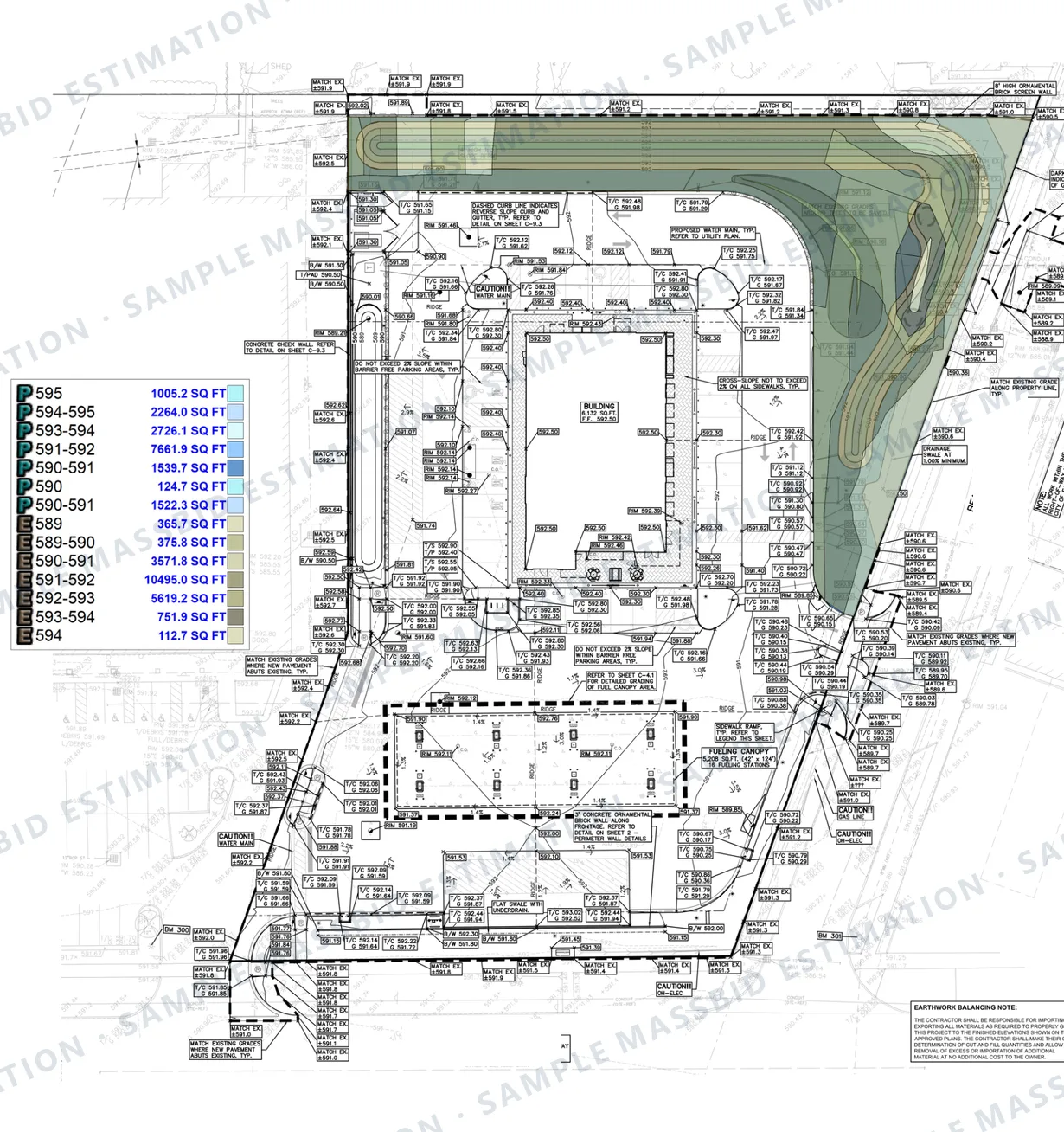
Pages from finished jobs: a fuel station site in Michigan and a commercial building site in Texas. Client names, street names and title blocks are removed; the quantities are as delivered. Click any page to enlarge.
Grading plan
Earthwork takeoff on a grading plan, area by contour band
Protects you fromA volume from one average depth.
Cut and fill report
Cut and fill summary by proposed contour
Protects you fromA net number with nothing behind it.
Erosion control
Erosion control takeoff: silt fence, inlet protection and detention pond
Protects you fromErosion control covered by a percentage.
Priced estimate
Priced earthwork estimate: compaction, soil treatment, cut, fill and haul-off
Protects you fromSoils-report requirements nobody priced.
Every estimate is built to the client's own specification, so yours may be laid out differently. To see a past project in your own trade, ask for an example. Examples are finished work for other projects, not an estimate of yours; for pricing on your own job, send the grading plans for a free quote.
A real earthwork estimate
Earthwork cost breakdown for a fuel station site
Line totals from one finished estimate: a fuel station site in Michigan of about 96,700 square feet.
Division 31 trade cost came to $97,492, about $1.01 per square foot of site. Moving the dirt itself, the cut, fill and import, was under $11,000. Erosion and sediment control was $27,910, compaction and chemical modification together $23,776, and hauling off 1,910 cubic yards of excess soil $13,131. Site utilities on the same job were $874,095 and are estimated separately.
Figures are from the delivered estimate, rounded to the dollar, with related lines combined. They are specific to that project and are shown to illustrate how an earthwork estimate is broken down, not as a price guide.
Real jobs, not a price list. Each figure comes from one project, priced for its own ZIP code and that client's wages, overhead and profit. Prices change by region and over time. Yours will be priced for your location.
| Item | Quantity | Cost |
|---|---|---|
| Erosion and sediment control | $27,910 | |
| Subgrade compaction, pad and hardscape | 66,632 SF | $16,058 |
| Haul-off of excess soil | 1,910 CY | $13,131 |
| Rough grading, site and building pad | 90,921 SF | $11,018 |
| Rock hammering allowance | $8,000 | |
| Chemical modification of subgrade | 66,632 SF | $7,718 |
| Fill | 664 CY | $5,475 |
| Imported soil | 468 CY | $3,864 |
| Clearing, grubbing and topsoil strip | 27,046 SF | $2,975 |
| Cut | 195 CY | $1,342 |
| Division 31 trade cost | $97,492 |
Building somewhere else? See figures from jobs in Texas, California, Florida and other service areas.
Full sample
Read a full sample, page by page
Earthwork, from a finished job: a childcare center site in Texas. Open it full screen, scroll through all 2 pages and zoom in on any line.
This is one real job, shown as an example. It was built to that client's own specification: their wage rates, labor style, type of pricing, and overhead and profit. Prices also change by region and over time, so yours will be priced for your location.
Want a current sample in your own trade or specialty, or have a question? Use the contact form, email [email protected] or call (832) 356-4237.
Who it is for
Earthwork estimating for grading contractors, sitework contractors and general contractors
Earthwork and grading contractors
Cut, fill, import and export with a contour-by-contour report, and grading and compaction by area.
Excavation estimatingSitework and civil contractors
Earthwork taken off with demolition, utilities, paving and site improvements as one package.
Exterior improvementsPaving contractors
Subgrade preparation, compaction and stabilization beneath the pavement section.
Asphalt paving estimatingGeneral contractors
An independent Division 31 number to check an earthwork quote, or to carry when none comes in.
GC estimating
Earthwork scopes we take off
- Clearing and grubbing
- Topsoil stripping and stockpile
- Mass cut and fill
- Import and export
- Rough and fine grading
- Building pad preparation
- Subgrade compaction
- Lime and chemical stabilization
- Rock removal
- Detention ponds and swales
- Silt fence and inlet protection
- Construction entrances and washouts
Pricing data
Where the prices come from
Quantities are priced from our own pricing database, built with local vendors across the United States. The estimator enters the project's ZIP code and gets current material prices for that market.
Material prices change from region to region and from month to month, so a price book or a national average is out of date before the bid goes in.
Priced by ZIP code
Current local material prices for the place the job is built, not a national average.
Updated by vendors
Local vendors update their prices in the database as they change.
Labor as you bid it
Union, open shop, or Davis-Bacon and prevailing wage rates with fringes.
How it works
From grading plans to a finished earthwork estimate
Send the drawings
The grading plan, the existing topographic survey, the erosion control plan, the geotechnical report, the Division 31 specification and addenda.
Free quote
We review the set and reply with a quote and a delivery date, usually within about 20 minutes.
Model, measure, price and two QA reviews
Existing and proposed surfaces are built and cut and fill calculated; grading, compaction and treatment are measured by area; erosion control is measured or counted. A separate QA team checks the surfaces and quantities, then the priced estimate.
Delivery and revisions
The package typically arrives within 24 to 48 hours. Addenda and grading revisions are handled free, with no time limit.
The work is done in-house by more than 20 estimators, typically with 7 to 10 years of industry experience.
What it costs
Earthwork estimating prices
- Single site
- From $199. Simple scopes typically run $100 to $250.
- Larger sites
- Typically $200 to $500. Large or multi-phase sites are quoted individually.
- Monthly plan
- From $1,499 for 10 to 15 projects, for earthwork contractors who bid every week.
Every job is quoted individually from the drawings, and the quote is free. See all pricing
After delivery
An editable Excel workbook and free revisions
- Formulas built in
An Excel workbook you can change yourself
The estimate arrives as an editable Excel workbook with the formulas built in. Change a quantity, a rate or a markup and every total follows. Move overhead and profit from 25% to 30% and the whole bid recalculates on the spot.
- No waiting
Adjust your bid at the last minute
If something changes just before the deadline, you do not have to send the estimate back and wait. Open the workbook, change the number and submit. The control stays with you.
- Priority turnaround
Free revisions, with no limit
Addenda, scope changes and pricing updates are all free, however many times you come back, and there is no time limit. Revisions are handled on priority and typically come back within an hour to a few hours.
Questions
Earthwork estimating FAQ
It is the takeoff and pricing of the work done to the ground before construction: clearing, stripping topsoil, cutting and filling to the design grades, importing or exporting soil, grading, compacting and stabilizing the subgrade, and controlling erosion. Volumes are calculated between existing and proposed grades and priced with labor, equipment and trucking.
Cut and fill volumes, net import or export, topsoil stripping, rough and fine grading areas, building pad preparation, subgrade compaction, soil stabilization, rock allowances, detention ponds, and erosion and sediment control such as silt fence, inlet protection and construction entrances.
Earthwork is the whole of the ground preparation: grading the site, building the pad, compaction, stabilization and erosion control. Excavation is the digging part of it, such as mass cut, trenches and footing excavation. The two are estimated from the same drawings and usually bid together; our excavation estimating page covers the cut and fill modeling in more detail.
The existing ground and the proposed ground are each built as a surface from contours and spot elevations, and the volume between them is calculated. Where the proposed surface is lower the difference is cut; where it is higher it is fill. On one fuel station site that came to 195 cubic yards of cut and 664 of fill.
Yes, where factors are given or requested. Excavated soil swells when loosened and shrinks when compacted, so truck volumes and required fill differ from bank volumes. The factor used is stated on the estimate so it can be changed.
Yes. Compaction requirements, subgrade treatment, undercut of unsuitable soil, topsoil depth and rock are taken from the soils report, and each line that comes from it carries the report page reference.
Yes. Silt fence and erosion logs are measured in linear feet, blankets by area, and inlet filters, construction entrances and washouts are counted. On one site, erosion control was $27,910 of a $97,492 earthwork estimate.
It varies widely with how much the grade changes and what the soils report requires. On one 96,700 square foot fuel station site we estimated, earthwork trade cost was about $1.01 per square foot of site before markups.
Yes. This page shows a full sample from a finished job (earthwork, for a childcare center site in Texas), which you can open full screen and read page by page. It was built to that client's own specification, so the wage rates, pricing and overhead and profit are theirs. Ask us for a current sample in your own trade.
From our own pricing database, built with local vendors across the United States. An estimator enters the project's ZIP code and gets current material prices for that market, and vendors update their prices as they change. Labor is priced as union or open shop, or at Davis-Bacon rates with fringes on government work.
Yes. The estimate is delivered as an editable Excel workbook with the formulas built in. Change any quantity, rate or markup and the whole estimate recalculates. If overhead and profit was set at 25% and you want 30%, change that one cell and every total updates, so you can adjust your number minutes before the bid is due without sending it back to us.
As many as you need. Every revision is free, including addenda, scope changes and pricing updates, however many times you come back, and there is no time limit. Revisions are handled on priority and are typically returned within an hour to a few hours, depending on the size of the change.
A single site starts at $199, and simple scopes typically run $100 to $250. Larger sites typically run $200 to $500, and large or multi-phase sites are quoted individually. The quote is free and usually comes back in about 20 minutes.
Yes. Every estimate is built to the client's own specification. Send your unit prices, equipment rates or template and the package is returned that way, or order quantities and the cut and fill report alone.
Related services and service areas
Have an earthwork bid due? Send the grading plans.
Free quote in about 20 minutes. Earthwork takeoffs and estimates typically in 24 to 48 hours, built to your format, with free revisions with no limit. Based in Houston and estimating earthwork in all 50 states.