For masonry contractors
Masonry estimating and takeoff services
Brick by type and bond, block by thickness and height, with grout, mortar, reinforcing, lintels and cast stone, counted and priced.
- Brick and block counts
- Grout, mortar and rebar
- 24 to 48 hours
In short
What masonry estimating covers
Masonry estimating is the takeoff and pricing of a building's brick, block and stone from the elevations, plans and wall sections: brick veneer, concrete masonry unit (CMU) walls, cast stone, grout, mortar, reinforcing, lintels and accessories. Wall area is measured by masonry type with openings deducted, then converted to brick and block counts, cubic yards of grout and mortar, and pounds of reinforcing. MassBid Estimation prepares masonry takeoffs and estimates for masonry contractors, general contractors and suppliers, typically in 24 to 48 hours.
- Scope
- Brick veneer, CMU walls, cast stone, grout, mortar, reinforcing, lintels, anchors and control joints
- CSI division
- 04 Masonry: 04 05 mortar and grout, 04 21 clay unit masonry, 04 22 concrete unit masonry, 04 72 cast stone
- You send
- Exterior elevations, plans, wall sections, structural masonry notes, the Division 04 spec and addenda
- You get
- Marked-up elevations and plans, a priced workbook with unit counts, and a material list
- Turnaround
- 24 to 48 hours on most projects
- Checked by
- A separate QA team, twice on every job
- Coverage
- All 50 states, priced to the project's ZIP code
- Quote
- Free, usually back in about 20 minutes
Thursday · 6:00 PM
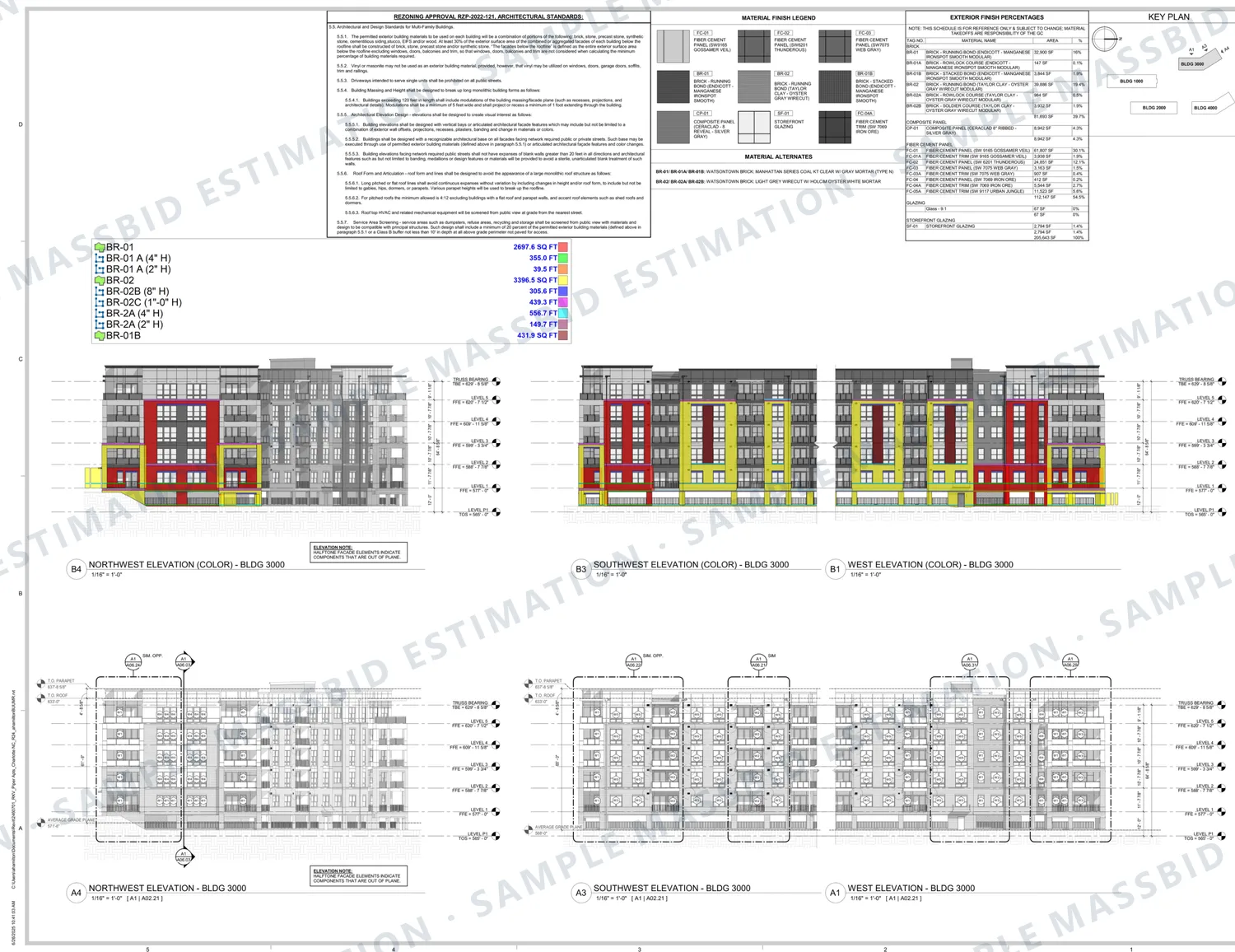
Two bricks, three bonds and a soldier course, and the elevation just says “brick.”
Brick is drawn as a hatch on an elevation. What the hatch stands for is in the material legend: which brick, which manufacturer, running bond or stacked, and where the rowlock sills and soldier courses run. Each of those is a different unit count and a different labor rate.
Block is the reverse problem. It is drawn on plan as a line, and the height, the reinforcing, the grouting and the bond beams are in the structural notes. A takeoff that measures the line and assumes the rest is a guess.
Four ways a masonry bid loses money
01 · The openings
Gross wall area priced without deducting openings
Windows, doors and storefronts can be a third of an elevation. Gross area overbuys brick; over-deducting forgets the returns and the lintels.
What changes
Brick is measured net of openings on the elevations, with returns and lintels taken separately.
02 · The types
Every brick priced as one brick
Two brick types, accent bands and special courses on one building mean different units, different prices and slower laying.
What changes
Each brick tag and each bond is measured on its own, with rowlock and soldier courses in linear feet.
03 · The core
Grout and reinforcing in CMU left out
A fully grouted, reinforced wall carries concrete and steel a hollow wall does not. On tall walls it is a large share of the cost.
What changes
Grout is calculated in cubic yards and bars in pounds from the spacing in the structural notes.
04 · The height
Walls priced without scaffolding and hoisting
Brick on the fifth floor is not laid at the same rate as brick at grade, and it needs staging, planking and hoisting to get there.
What changes
Quantities are kept by building and elevation, and scaffolding and hoisting are carried as their own lines.
Then and now
What has changed in masonry estimating
Masonry used to be estimated from wall area and a count per square foot. Four things have changed the takeoff.
Brick is a veneer, not a wall
Most brick now hangs on a framed or block backup with an air space, anchors and flashing. Anchors, ties and relief angles are quantities that a solid wall never had.
More brick types per elevation
Design standards often require material changes across a facade. Two or three bricks and several bonds on one building are now routine.
Reinforced, grouted block
Structural codes have increased the reinforcing and grouting in CMU, especially in stair and elevator shafts. Block count alone no longer prices the wall.
Fewer masons, higher labor share
Skilled labor is the larger part of a masonry price. An estimate has to show labor hours per line, not just units.
Real masonry work
Sample masonry takeoffs and estimates
Pages from finished jobs: a five-story apartment community in North Carolina and a brick-and-block building in New York. Client names, addresses and title blocks are removed; the quantities are as delivered. Click any page to enlarge.
Brick veneer
Brick takeoff on apartment elevations, by brick type and bond
Protects you fromTwo bricks ordered as one.
By elevation
Brick veneer takeoff by type on the north and west elevations
Protects you fromBrick bought for the windows.
CMU walls
CMU wall takeoff on a foundation plan, by height and bond beam
Protects you fromA shaft wall priced at one story.
Priced estimate
Priced masonry estimate: CMU, brick veneer and cast stone with unit counts
Protects you fromA price per square foot with no unit count.
Every estimate is built to the client's own specification, so yours may be laid out differently. To see a past project in your own trade, ask for an example. Examples are finished work for other projects, not an estimate of yours; for pricing on your own job, send the drawings for a free quote.
A real masonry estimate
Masonry cost breakdown for a brick-and-block building
Line totals from one finished masonry estimate: a building in New York with 6,801 square feet of brick veneer and about 5,270 square feet of CMU.
Direct cost came to $456,898: $112,703 of material and $344,196 of labor, across 4,193 man-hours. Brick veneer worked out at about $34.60 per square foot in place and 8-inch reinforced block at about $20.90, before grout and mortar. The takeoff counted 60,782 bricks and 5,917 blocks. With general requirements, burden, overhead and profit the project total was $699,793.
Figures are from the delivered estimate, labor plus material before markups, rounded to the dollar, with related lines combined. They are specific to that project and are shown to illustrate how a masonry estimate is broken down, not as a price guide.
Real jobs, not a price list. Each figure comes from one project, priced for its own ZIP code and that client's wages, overhead and profit. Prices change by region and over time. Yours will be priced for your location.
| Item | Quantity | Cost |
|---|---|---|
| Brick veneer, two types | 6,801 SF | $235,238 |
| 8-inch reinforced CMU wall | 4,895 SF | $102,507 |
| Ground-face block cavity wall | 465 SF | $28,388 |
| Grout and mortar for CMU | 57 CY | $18,099 |
| Brick stacked bond at windows | 691 LF | $16,235 |
| Cast stone sills and bands | 252 LF | $14,623 |
| Steel angle lintels | 211 LF | $14,099 |
| Bond beam, reinforced | 453 LF | $9,747 |
| Cast stone header | 137 LF | $6,974 |
| Trash enclosure CMU walls | 234 SF | $5,740 |
| Brick ties | 2,497 EA | $2,880 |
| 4-inch CMU wall | 144 SF | $2,368 |
| Masonry direct cost | $456,898 |
Building somewhere else? See figures from jobs in Texas, California, Florida and other service areas.
Full sample
Read a full sample, page by page
Masonry, from a finished job: a outdoor structure in Ohio. Open it full screen, scroll through the page and zoom in on any line.
This is one real job, shown as an example. It was built to that client's own specification: their wage rates, labor style, type of pricing, and overhead and profit. Prices also change by region and over time, so yours will be priced for your location.
Want a current sample in your own trade or specialty, or have a question? Use the contact form, email [email protected] or call (832) 356-4237.
Who it is for
Masonry estimating for masonry contractors, general contractors and suppliers
Masonry contractors
Brick and block counts, grout, mortar and a priced estimate with labor hours for each bid, in your format.
Commercial estimatingConcrete and masonry contractors
Foundations, slabs and block walls taken off together where you carry both.
Concrete estimatingGeneral contractors
An independent Division 04 number to check a masonry quote, or to carry when none comes in.
GC estimatingBrick and block suppliers
Unit counts by type with waste, plus accessories, limited to what you sell.
Supplier takeoffs
Masonry scopes we take off
- Brick veneer
- Rowlock, soldier and stacked courses
- CMU and block walls
- Fire-rated shaft walls
- Grout and mortar
- Masonry reinforcing
- Bond beams and lintels
- CMU piers and pilasters
- Cast stone and precast trim
- Stone veneer
- Anchors, ties and control joints
- Scaffolding and hoisting
Pricing data
Where the prices come from
Quantities are priced from our own pricing database, built with local vendors across the United States. The estimator enters the project's ZIP code and gets current material prices for that market.
Material prices change from region to region and from month to month, so a price book or a national average is out of date before the bid goes in.
Priced by ZIP code
Current local material prices for the place the job is built, not a national average.
Updated by vendors
Local vendors update their prices in the database as they change.
Labor as you bid it
Union, open shop, or Davis-Bacon and prevailing wage rates with fringes.
How it works
From drawings to a finished masonry estimate
Send the drawings
Exterior elevations, plans, wall sections, the structural masonry notes, the Division 04 specification and addenda, plus your own production rates or template.
Free quote
We review the set and reply with a quote and a delivery date, usually within about 20 minutes.
Measure, count, price and two QA reviews
Brick is measured by type on the elevations and block by height on the plans, then converted to unit counts, grout, mortar and reinforcing. A separate QA team checks the quantities, then the priced estimate.
Delivery and revisions
The package typically arrives within 24 to 48 hours. Addenda and revisions are free, with no limit and no time limit, and are handled on priority.
The work is done in-house by more than 20 estimators, typically with 7 to 10 years of industry experience.
What it costs
Masonry estimating prices
- Single project
- From $199. Simple scopes typically run $100 to $250.
- Larger buildings
- Typically $200 to $500. Large or multi-building projects are quoted individually.
- Monthly plan
- From $1,499 for 10 to 15 projects, for masonry contractors who bid every week.
Every job is quoted individually from the drawings, and the quote is free. See all pricing
After delivery
An editable Excel workbook and free revisions
- Formulas built in
An Excel workbook you can change yourself
The estimate arrives as an editable Excel workbook with the formulas built in. Change a quantity, a rate or a markup and every total follows. Move overhead and profit from 25% to 30% and the whole bid recalculates on the spot.
- No waiting
Adjust your bid at the last minute
If something changes just before the deadline, you do not have to send the estimate back and wait. Open the workbook, change the number and submit. The control stays with you.
- Priority turnaround
Free revisions, with no limit
Addenda, scope changes and pricing updates are all free, however many times you come back, and there is no time limit. Revisions are handled on priority and typically come back within an hour to a few hours.
Questions
Masonry estimating FAQ
It is the takeoff and pricing of a building's brick, block and stone. Wall area is measured by masonry type with openings deducted, converted to brick and block counts, grout and mortar are calculated, reinforcing, lintels and cast stone are added, and labor and material prices are applied to produce an estimate a masonry contractor can bid from.
Brick veneer by type and bond, special courses in linear feet, CMU walls by thickness and height with block counts, grout, mortar, vertical bars and joint reinforcement, bond beams, lintels, piers, cast stone, anchors and ties, control joints, and scaffolding where it is in the scope.
About 6.75 to 7 standard modular bricks per square foot of wall with a 3/8-inch joint, before waste. Other brick sizes differ, so the count is calculated from the unit size on the drawings. One estimate on this page, with a smaller unit, counted 60,782 bricks for 6,801 square feet of veneer.
A standard 8 by 16 inch block covers 0.89 square feet, so there are 1.125 blocks per square foot of wall. A 4,895 square foot wall in the estimate on this page took 5,494 blocks.
Yes. Grout is calculated in cubic yards for the grouted cells, mortar in cubic yards from the wall area, vertical bars in pounds from their spacing, and horizontal joint reinforcement in linear feet.
Yes. Brick and block are measured net of windows, doors and storefronts, and the lintels, sills and returns at those openings are measured separately.
It depends on the unit, the bond and the height. On one building we estimated, brick veneer was about $34.60 per square foot in place and 8-inch reinforced CMU about $20.90, before grout, mortar and markups. Labor was about three quarters of the direct cost.
Division 04 Masonry. Mortar and grout are 04 05, clay unit masonry (brick) 04 21, concrete unit masonry (CMU) 04 22, stone 04 40 and cast stone 04 72.
Yes. This page shows a full sample from a finished job (masonry, for a outdoor structure in Ohio), which you can open full screen and read page by page. It was built to that client's own specification, so the wage rates, pricing and overhead and profit are theirs. Ask us for a current sample in your own trade.
From our own pricing database, built with local vendors across the United States. An estimator enters the project's ZIP code and gets current material prices for that market, and vendors update their prices as they change. Labor is priced as union or open shop, or at Davis-Bacon rates with fringes on government work.
Yes. The estimate is delivered as an editable Excel workbook with the formulas built in. Change any quantity, rate or markup and the whole estimate recalculates. If overhead and profit was set at 25% and you want 30%, change that one cell and every total updates, so you can adjust your number minutes before the bid is due without sending it back to us.
As many as you need. Every revision is free, including addenda, scope changes and pricing updates, however many times you come back, and there is no time limit. Revisions are handled on priority and are typically returned within an hour to a few hours, depending on the size of the change.
A single project starts at $199, and simple scopes typically run $100 to $250. Larger buildings typically run $200 to $500, and large or multi-building projects are quoted individually. The quote is free and usually comes back in about 20 minutes.
Yes. Every estimate is built to the client's own specification. Send your production rates, unit prices or template and the package is returned that way, or order unit counts alone and price them yourself.
Related services and service areas
Have a masonry bid due? Send the drawings.
Free quote in about 20 minutes. Masonry takeoffs and estimates typically in 24 to 48 hours, built to your format, with free revisions with no limit. Based in Houston and estimating masonry in all 50 states.