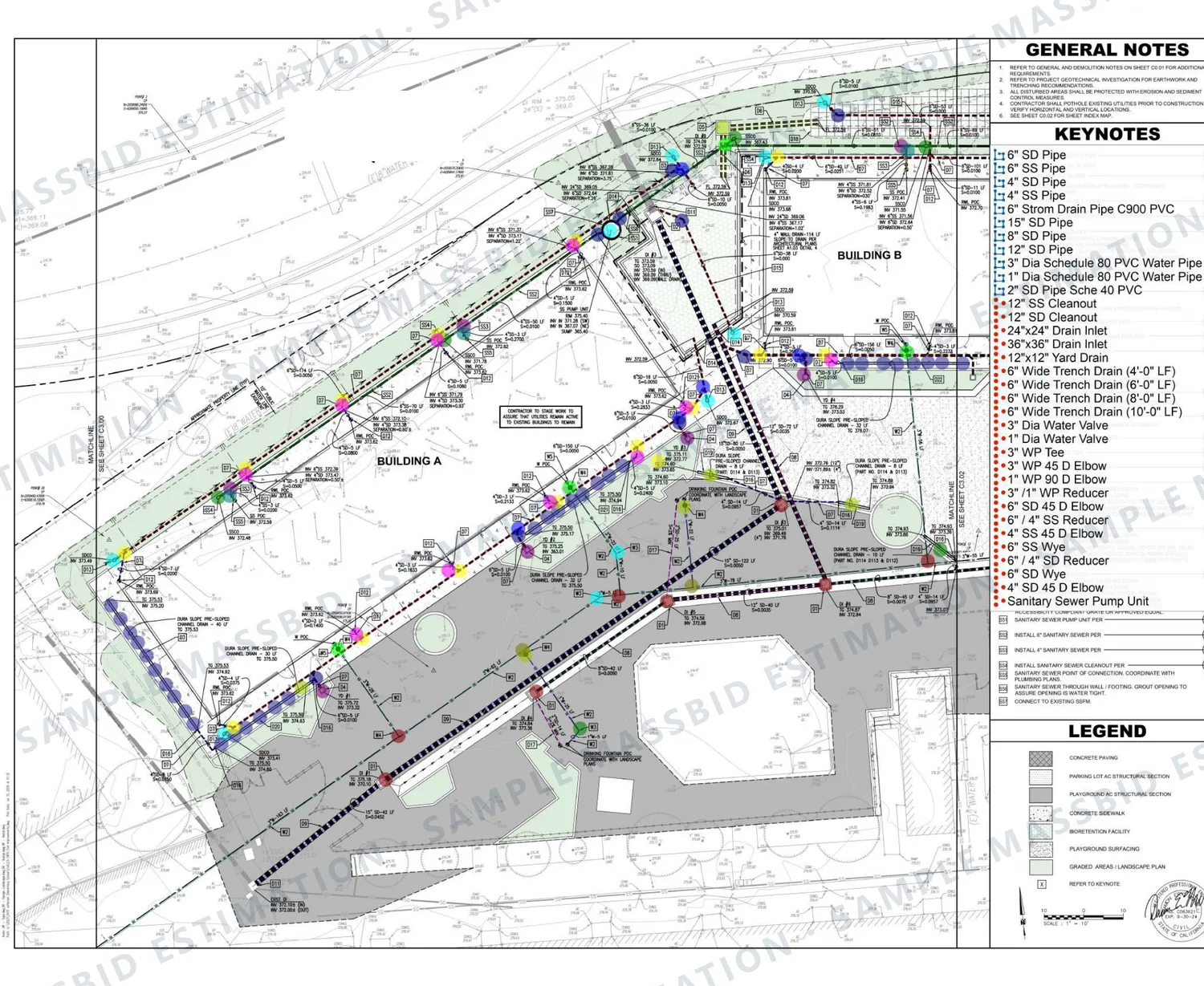
For utility and sitework contractors
Site utilities estimating and takeoff services
Storm, sanitary and water pipe by size, every structure by depth, and the trench excavation, bedding and backfill under each run, priced line by line.
- Pipe by size and material
- Trench volumes per run
- 24 to 48 hours
In short
What site utilities estimating covers
Site utilities estimating is the takeoff and pricing of the underground work outside a building: storm drainage, sanitary sewer, domestic and fire water, and the structures on them, with the trench excavation, bedding and backfill each run needs. Pipe is measured by size and material, structures are counted by type and depth, and trench volumes are calculated for every run. MassBid Estimation prepares site utility takeoffs and estimates for utility, sitework and excavation contractors and general contractors, typically in 24 to 48 hours.
- Scope
- Storm drainage, sanitary sewer, water, structures, fittings, detention, trenching, bedding and backfill
- CSI division
- 33 Utilities: 33 10 water, 33 30 sanitary sewerage, 33 40 storm drainage
- You send
- Utility plans, profiles, structure schedules, trench details, soils report, specs and addenda
- You get
- Marked-up utility plans with pipe by size and structures dotted, and a priced workbook
- Turnaround
- 24 to 48 hours on most projects
- Checked by
- A separate QA team, twice on every job
- Coverage
- All 50 states, priced to the project's ZIP code
- Quote
- Free, usually back in about 20 minutes
Tuesday · 6:10 AM
The pipe was priced by the foot. Nobody priced the hole it goes in.
Utility plans show pipe as a line with a size written beside it, so the pipe is the easy part to take off. The depth is somewhere else: in the profiles, the invert elevations and the structure schedule.
Depth is what the job costs. A twelve-inch sewer at four feet and the same pipe at thirteen feet are different trenches, with different excavation, shoring, bedding and backfill. On most sites the digging costs more than the pipe.
Four ways a utilities bid loses money
01 · The trench
Excavation and backfill priced as an allowance
Trench volume depends on the depth and width of every run. On one site we estimated, it was close to half the utility cost.
What changes
Excavation, bedding and backfill are calculated for each run and listed beneath it.
02 · The structures
Manholes and basins counted without depth
A manhole is priced by its diameter and depth. Counting them as each loses most of the difference.
What changes
Each structure is listed by tag with its diameter and depth from the schedule or profile.
03 · The fittings
Fittings, cleanouts and valves left off
Bends, wyes, reducers, cleanouts and valves are small symbols on a crowded plan.
What changes
Fittings and appurtenances are counted by type and size.
04 · The specials
Detention, interceptors and treatment units missed
Underground detention systems, grease interceptors and water quality units are single items that can each cost as much as a run of pipe.
What changes
Each is taken off from its detail with its excavation, stone and fabric.
Then and now
What has changed in site utilities estimating
Site utilities used to be pipe footage and a count of structures. Four things have changed the takeoff.
Stormwater is treated on site
Underground detention, bioretention and water quality units are now required on ordinary commercial sites and are a large part of the storm scope.
Pipe prices move
PVC, HDPE and ductile iron prices have been volatile, so pipe by size and material has to stand apart from the price.
Trench safety and backfill
Bedding classes, compacted backfill and trench protection are specified and inspected, and they are real quantities.
Crowded corridors
Gas, power and communications share trenches with wet utilities, and who digs for whom has to be spelled out.
Real utility work
Sample site utility takeoffs and estimates
Pages from finished jobs: a school site in California, a drive-through site in Georgia and a fuel station site in Michigan. Client names, street names and title blocks are removed; the quantities are as delivered. Click any page to enlarge.
Utility plan
Site utilities takeoff: storm, sewer and water pipe by size
Protects you fromPipe measured without its size.
Fittings
Pipe, fittings, cleanouts and valves on the next sheet
Protects you fromFittings nobody counted.
Services
Water and sewer service takeoff with grease interceptor
Protects you fromA small site priced as a lump sum.
Priced estimate
Priced utilities estimate: pipe with excavation, bedding and backfill
Protects you fromPipe priced without its trench.
Every estimate is built to the client's own specification, so yours may be laid out differently. To see a past project in your own trade, ask for an example. Examples are finished work for other projects, not an estimate of yours; for pricing on your own job, send the civil drawings for a free quote.
A real utilities estimate
Site utilities cost breakdown for a fuel station site
Group totals from one finished estimate: a fuel station site in Michigan of about 96,700 square feet.
Division 33 trade cost came to $874,095, or $9.04 per square foot of site, nine times the earthwork on the same job. Trench excavation, bedding and backfill were about $398,000, roughly 46% of the total, more than all the pipe. The six sanitary manholes were up to 13 ft deep and averaged about $15,000 each.
Figures are from the delivered estimate, rounded to the dollar, with each group including its own excavation, bedding and backfill. They are specific to that project and are not a price guide.
Real jobs, not a price list. Each figure comes from one project, priced for its own ZIP code and that client's wages, overhead and profit. Prices change by region and over time. Yours will be priced for your location.
| Item | Quantity | Cost |
|---|---|---|
| Storm drainage and underdrain pipe | 2,063 LF | $234,900 |
| Water main and service | $140,403 | |
| Sanitary sewer pipe | 508 LF | $131,975 |
| Underground detention system | 1 EA | $103,850 |
| Precast sanitary manholes | 6 EA | $90,289 |
| Catch basins | 6 EA | $47,277 |
| PVC storm water pipe | 1,045 LF | $44,307 |
| Grease interceptor tank, 2,000 gallon | 1 EA | $35,927 |
| Hydrant, cleanouts and outlet control | $21,975 | |
| Water quality unit | 1 EA | $18,547 |
| Trenching for gas and electrical | $4,646 | |
| Division 33 trade cost | $874,095 |
Building somewhere else? See figures from jobs in Texas, California, Florida and other service areas.
Full sample
Read a full sample, page by page
Site utilities, from a finished job: a convenience store and fuel site in Michigan. Open it full screen, scroll through all 8 pages and zoom in on any line.
This is one real job, shown as an example. It was built to that client's own specification: their wage rates, labor style, type of pricing, and overhead and profit. Prices also change by region and over time, so yours will be priced for your location.
Want a current sample in your own trade or specialty, or have a question? Use the contact form, email [email protected] or call (832) 356-4237.
Who it is for
Utilities estimating for utility contractors, sitework contractors and general contractors
Underground utility contractors
Pipe by size, structures by depth and trench volumes per run, priced in your format.
Excavation estimatingSitework contractors
Utilities taken off with the earthwork and paving as one site package.
Earthwork estimatingPlumbing contractors
Site services from the building to the main, where they are in your scope.
Plumbing estimatingGeneral contractors
An independent Division 33 number to check a utility quote, or to carry when none comes in.
GC estimating
Utility scopes we take off
- Storm drain pipe
- Sanitary sewer pipe
- Water mains and services
- Fire lines and hydrants
- Manholes
- Catch basins and inlets
- Cleanouts and valves
- Pipe fittings
- Underground detention
- Grease interceptors
- Trench drains and underdrains
- Trenching, bedding and backfill
Pricing data
Where the prices come from
Quantities are priced from our own pricing database, built with local vendors across the United States. The estimator enters the project's ZIP code and gets current material prices for that market.
Material prices change from region to region and from month to month, so a price book or a national average is out of date before the bid goes in.
Priced by ZIP code
Current local material prices for the place the job is built, not a national average.
Updated by vendors
Local vendors update their prices in the database as they change.
Labor as you bid it
Union, open shop, or Davis-Bacon and prevailing wage rates with fringes.
How it works
From civil drawings to a finished utilities estimate
Send the drawings
Utility plans, storm and sanitary profiles, structure schedules, trench and bedding details, the soils report, the Division 33 specification and addenda.
Free quote
We review the set and reply with a quote and a delivery date, usually within about 20 minutes.
Measure, calculate, price and two QA reviews
Pipe is measured by size, structures and fittings are counted, and trench volumes are calculated from depths and details. A separate QA team checks the quantities against the profiles, then the priced estimate.
Delivery and revisions
The package typically arrives within 24 to 48 hours. Addenda and revisions are free, with no limit and no time limit, and are handled on priority.
The work is done in-house by more than 20 estimators, typically with 7 to 10 years of industry experience.
What it costs
Site utilities estimating prices
- Single site
- From $199. Simple scopes typically run $100 to $250.
- Larger sites
- Typically $200 to $500. Large or multi-phase sites are quoted individually.
- Monthly plan
- From $1,499 for 10 to 15 projects, for utility contractors who bid every week.
Every job is quoted individually from the drawings, and the quote is free. See all pricing
After delivery
An editable Excel workbook and free revisions
- Formulas built in
An Excel workbook you can change yourself
The estimate arrives as an editable Excel workbook with the formulas built in. Change a quantity, a rate or a markup and every total follows. Move overhead and profit from 25% to 30% and the whole bid recalculates on the spot.
- No waiting
Adjust your bid at the last minute
If something changes just before the deadline, you do not have to send the estimate back and wait. Open the workbook, change the number and submit. The control stays with you.
- Priority turnaround
Free revisions, with no limit
Addenda, scope changes and pricing updates are all free, however many times you come back, and there is no time limit. Revisions are handled on priority and typically come back within an hour to a few hours.
Questions
Site utilities estimating FAQ
It is the takeoff and pricing of underground storm, sanitary and water systems outside a building. Pipe is measured by size and material, structures are counted by type and depth, trench excavation, bedding and backfill are calculated for each run, and labor, equipment and material prices are applied.
Storm, sanitary and water pipe by diameter and material, fittings, manholes, catch basins, inlets, cleanouts, valves, hydrants and meters, detention and treatment units, grease interceptors, and trench excavation, bedding and backfill.
For each run, the trench width from the detail is multiplied by its depth from the profiles or invert elevations and by its length. Bedding and compacted backfill are taken from the trench detail and the rest is final backfill.
Often close to half. On one fuel station site we estimated, trench excavation, bedding and backfill were about $398,000 of an $874,095 utilities estimate, roughly 46%.
Yes. Each structure is listed by its tag with diameter and depth. On one site, six sanitary manholes ranged from about 9 ft to 13 ft deep and were priced individually.
Yes. The system is taken from its detail with bulk excavation, stone layers, fabric and end caps. One on a fuel station site came to $103,850.
Yes. Excavation and earthwork cover grading the site and building the pad. Site utilities cover the pipe and structures in the ground and the trenches they sit in. They are estimated from the same civil set and are often bid together.
Yes. This page shows a full sample from a finished job (site utilities, for a convenience store and fuel site in Michigan), which you can open full screen and read page by page. It was built to that client's own specification, so the wage rates, pricing and overhead and profit are theirs. Ask us for a current sample in your own trade.
From our own pricing database, built with local vendors across the United States. An estimator enters the project's ZIP code and gets current material prices for that market, and vendors update their prices as they change. Labor is priced as union or open shop, or at Davis-Bacon rates with fringes on government work.
Yes. The estimate is delivered as an editable Excel workbook with the formulas built in. Change any quantity, rate or markup and the whole estimate recalculates. If overhead and profit was set at 25% and you want 30%, change that one cell and every total updates, so you can adjust your number minutes before the bid is due without sending it back to us.
As many as you need. Every revision is free, including addenda, scope changes and pricing updates, however many times you come back, and there is no time limit. Revisions are handled on priority and are typically returned within an hour to a few hours, depending on the size of the change.
Division 33 Utilities: water utilities 33 10, sanitary sewerage 33 30 and storm drainage 33 40.
A single site starts at $199 and larger sites typically run $200 to $500; the quote is free and usually back in about 20 minutes. Every estimate is built to the client's own specification, with your unit prices and format if you send them.
Related services and service areas
Have a utilities bid due? Send the civil drawings.
Free quote in about 20 minutes. Site utility takeoffs and estimates typically in 24 to 48 hours, built to your format, with free revisions with no limit. Based in Houston and estimating site work in all 50 states.