For general contractors, subcontractors and developers
Commercial construction estimating services
Every division on the drawings taken off, priced and checked twice, so the number you carry on bid day is one you can open up and defend.
- Organized by CSI division
- Two QA reviews on every job
- 24 to 48 hours
In short
What commercial estimating covers
Commercial construction estimating is the takeoff and pricing of a commercial building from its drawings and specifications, division by division: sitework, concrete, steel, envelope, interiors, and the mechanical, electrical and plumbing. MassBid Estimation prepares commercial quantity takeoffs and cost estimates for general contractors, subcontractors, developers and suppliers, built to each client's bid format and typically delivered in 24 to 48 hours.
- Sectors
- Retail, office, healthcare, hospitality, education, restaurants, tenant improvements
- You send
- Drawings, specifications and addenda, the bid form, and your own template if you have one
- You get
- Marked-up plans, a priced workbook by CSI division and a material list, built to your specification
- Turnaround
- 24 to 48 hours on most projects
- Checked by
- A separate QA team, twice on every job
- Coverage
- All 50 states, priced to the project's ZIP code
- Quote
- Free, usually back in about 20 minutes
Bid day · 1:15 PM
The bid closes at two. Three sub numbers are still missing, and one that came in is half the others.
On a commercial bid the hard part is rarely the arithmetic. It is knowing, with forty minutes left, whether the low drywall number left out the shaft walls, and what to carry for the trade nobody quoted.
You can only answer that if you have your own quantities. Most contractors do not have the hours to take off every division on every job they chase, so they bid on trust, and find out after award which numbers deserved it.
Four ways a commercial bid loses money
01 · The scope gap
The work nobody priced
Firestopping, blocking for wall-hung equipment, roof curbs, access panels, final cleaning. Every trade assumes another trade has it. On bid day it belongs to nobody, and after award it belongs to you.
What changes
Each division is taken off from the drawings, so the gaps between trades show up as lines, not surprises.
02 · The late addendum
Addendum 3, issued the night before
A revised finish schedule or a changed structural sheet arrives after the takeoff is done. The bid goes in on the old quantities because there was no time to go back through the set.
What changes
Addenda are worked into the takeoff and the estimate is revised free, as many times as needed.
03 · The drawing and the spec
When the plans and the project manual disagree
The drawings show one partition type and the specification calls for another. Whoever guesses quietly carries the difference for the rest of the job.
What changes
Conflicts are written down as clarifications or assumptions, with the sheets and sections named.
04 · The bid form
Alternates, unit prices and a breakdown you did not plan for
The owner wants three alternates, a schedule of values and unit prices for unforeseen work. A single lump sum has to be pulled apart at the last minute.
What changes
The estimate is built by division from the start and returned in the format the bid form asks for.
Then and now
What has changed in commercial estimating
A commercial job used to be bid from a roll of drawings, a cost book and the square-foot price of the last one like it. Four things have made that approach risky.
Bid sets are larger and move later
A mid-size commercial job can run to hundreds of sheets plus a project manual, and addenda keep arriving in the last week. The takeoff has to be organized well enough to be revised, not just finished.
Last year's cost per square foot is not a price
Material and labor costs have moved quickly in recent years, and long-lead equipment can decide the schedule. A square-foot figure from a past job is a sanity check, not a bid.
The takeoff left the paper
Quantities are measured on screen from PDFs and, increasingly, from models. Done properly, every line in the estimate points back to a colored mark on a sheet that anyone can check.
Owners want the number broken down
Bid forms now routinely ask for a breakdown by division, alternates and unit prices. An estimate that is organized by CSI division from the first line answers that without rework.
Real commercial work
Sample commercial takeoffs and estimates
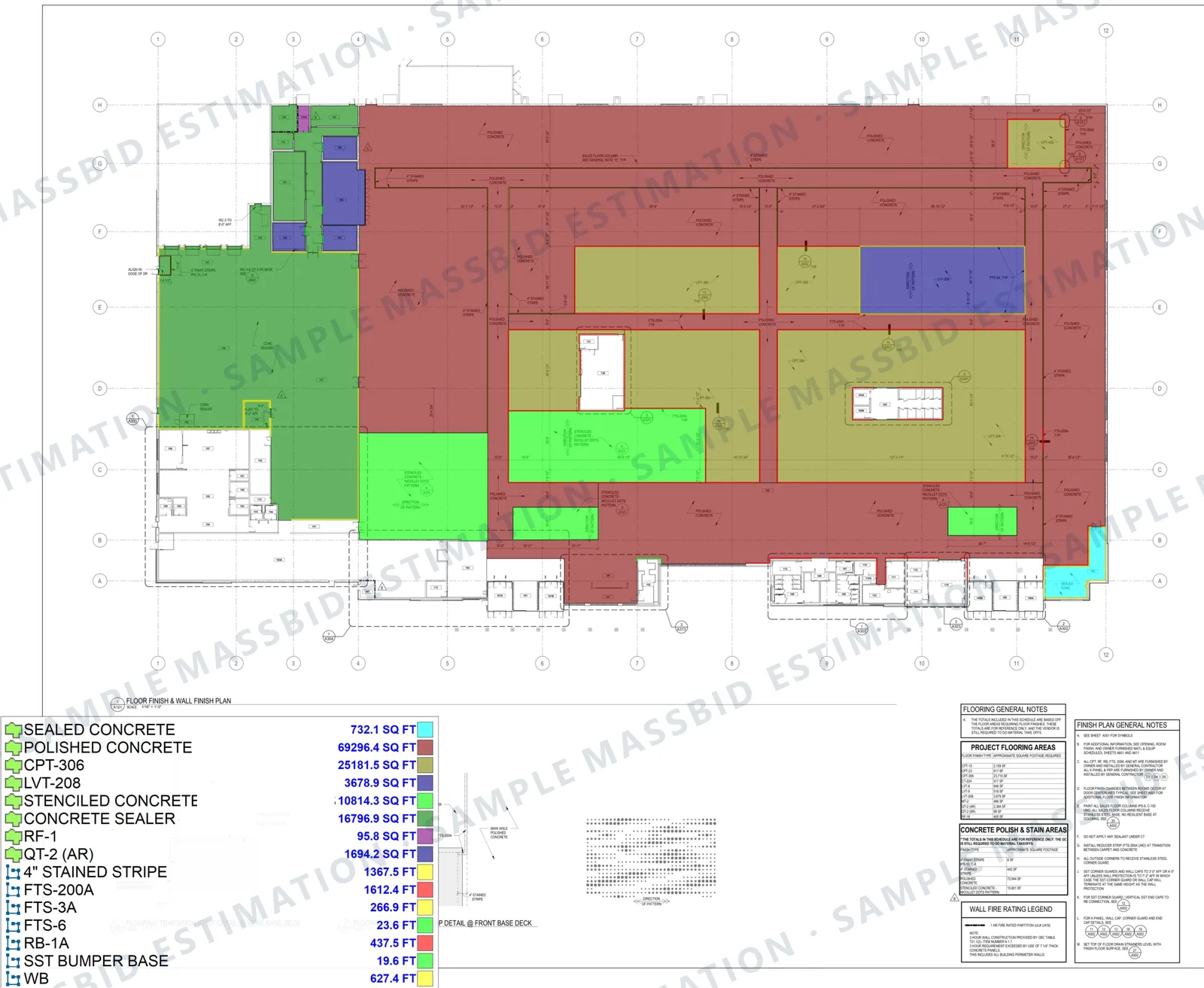
Pages from finished jobs: a retail store in California, a clinic expansion and a commercial building in Texas, a retail shell in Georgia and a hotel in Florida. Client names, addresses and title blocks are removed; the quantities are as delivered. Click any page to enlarge.
Flooring
Commercial flooring takeoff by finish for a retail store
Protects you fromOne blended floor area priced at the wrong finish.
Structural steel
Structural steel takeoff from a roof framing plan
Protects you fromSteel priced by the ton from a guess at the tonnage.
Storefront and glazing
Aluminum storefront and door count takeoff for a retail shell
Protects you fromA glazing bid that misses the one odd-size opening.
Priced estimate
Priced commercial estimate sheet with labor and material for each line
Protects you fromA division total you cannot open up when the owner asks.
Every estimate is built to the client's own specification, so yours may be laid out differently. To see a past project in your own trade, ask for an example. Examples are finished work for other projects, not an estimate of yours; for pricing on your own job, send the bid set for a free quote.
A real building, by division
Commercial construction cost by CSI division
Division costs from one finished estimate: a single-story commercial building in Texas of about 10,100 square feet, estimated as a full general-contractor package.
Trade cost came to $3,621,132, or $357.15 per square foot, before overhead and profit, labor burden, insurance, contingency and tax. Exterior improvements, the paving and site work, was the largest division on this job and HVAC the second, which is why a building-only square-foot figure would have missed it badly.
Figures are from the delivered estimate. They are specific to that project and are shown to illustrate how an estimate is broken down, not as a price guide.
| Division | Cost | Per sq ft | |
|---|---|---|---|
| General requirements | $180,000 | $17.75 | |
| Concrete | $257,106 | $25.36 | |
| Metals | $73,320 | $7.23 | |
| Wood, plastics and composites | $183,893 | $18.14 | |
| Thermal and moisture protection | $98,710 | $9.74 | |
| Openings | $119,853 | $11.82 | |
| Finishes | $399,381 | $39.39 | |
| Specialties | $17,104 | $1.69 | |
| Equipment | $230,994 | $22.78 | |
| Furnishings | $113,740 | $11.22 | |
| Fire suppression | $100,300 | $9.89 | |
| Plumbing | $275,971 | $27.22 | |
| HVAC | $429,863 | $42.40 | |
| Electrical | $196,494 | $19.38 | |
| Communications | $131,937 | $13.01 | |
| Exterior improvements | $615,558 | $60.71 | |
| Utilities | $196,908 | $19.42 | |
| Total trade cost | $3,621,132 | $357.15 |
Full sample
Read a full sample, page by page
General contractor estimate, from a finished job: a restaurant fit-out, 1,375 sq ft in Texas. Open it full screen, scroll through all 8 pages and zoom in on any line.
This is one real job, shown as an example. It was built to that client's own specification: their wage rates, labor style, type of pricing, and overhead and profit. Prices also change by region and over time, so yours will be priced for your location.
Want a current sample in your own trade or specialty, or have a question? Use the contact form, email [email protected] or call (832) 356-4237.
Who it is for
Commercial estimating for contractors, subcontractors and developers
General contractors
Every division on the drawings in one package, so you can check sub numbers against your own quantities and cover the trades nobody bid.
GC estimatingSubcontractors
Your trade isolated from the full set (flooring, drywall, steel, glazing, MEP), taken off, priced and placed in the form the GC asked for.
Trade estimatingDevelopers and owners
A budget by division before the documents are complete, tightened into a full estimate as the design develops.
Preliminary estimatingSuppliers and manufacturers
Quantities only, limited to the products you sell, with color-keyed drawings and every assumption numbered.
Supplier takeoffs
Commercial project types we estimate
- Retail stores and shopping centers
- Tenant improvements and fit-outs
- Office buildings
- Restaurants
- Hotels and hospitality
- Medical and healthcare
- Schools and childcare
- Shell buildings
- Mixed-use developments
- Renovations and expansions
How it works
From bid set to a finished estimate
Send the bid set
Drawings, the project manual, addenda and the bid form, plus the trades you want covered and your own template or cost codes.
Free quote
We review the set and reply with a quote and a delivery date, usually within about 20 minutes.
Takeoff, pricing and two QA reviews
Estimators measure and price each division. A separate QA team checks the quantities, then checks the priced estimate against the specifications and your notes.
Delivery, addenda and revisions
The package typically arrives within 24 to 48 hours. Addenda and revisions are free, with no limit and no time limit, and are handled on priority.
The work is done in-house by more than 20 estimators, typically with 7 to 10 years of industry experience.
What it costs
Commercial estimating prices
- Single trade
- From $199. Simple scopes typically run $100 to $250.
- Multi-trade
- Typically $200 to $500. Large or complex commercial packages are quoted individually.
- Monthly plan
- From $1,499 for 10 to 15 projects, for contractors who bid every week.
Every job is quoted individually from the drawings, and the quote is free. See all pricing
After delivery
An editable Excel workbook and free revisions
- Formulas built in
An Excel workbook you can change yourself
The estimate arrives as an editable Excel workbook with the formulas built in. Change a quantity, a rate or a markup and every total follows. Move overhead and profit from 25% to 30% and the whole bid recalculates on the spot.
- No waiting
Adjust your bid at the last minute
If something changes just before the deadline, you do not have to send the estimate back and wait. Open the workbook, change the number and submit. The control stays with you.
- Priority turnaround
Free revisions, with no limit
Addenda, scope changes and pricing updates are all free, however many times you come back, and there is no time limit. Revisions are handled on priority and typically come back within an hour to a few hours.
Questions
Commercial estimating FAQ
It is the takeoff and pricing of a commercial building from its drawings and specifications. Quantities are measured for each CSI division, labor hours and material costs are applied, and the result is an estimate a contractor can bid from. MassBid prepares these for retail, office, healthcare, hospitality, education and tenant-improvement projects.
A single trade starts at $199, and simple scopes typically run $100 to $250. Standard multi-trade projects typically run $200 to $500. Large or complex commercial packages are quoted individually from the drawings. The quote is free and usually comes back in about 20 minutes.
Most commercial takeoffs and estimates are delivered within 24 to 48 hours of receiving the bid set. Very large plan sets are given a delivery date with the quote, agreed before work begins.
Whatever is on the drawings: sitework and utilities, concrete, masonry, structural steel, rough and finish carpentry, roofing and envelope, doors and glazing, drywall, flooring, ceilings and paint, specialties and equipment, fire suppression, plumbing, HVAC, electrical and low voltage. A general contractor can order the whole set; a subcontractor can order one division.
Send it and the takeoff is updated. Addenda and revisions are free with no limit. Because the estimate is organized by division and each line points to a sheet, an addendum usually changes a handful of lines rather than the whole estimate.
Yes. Every estimate is built to the client's own specification. Send the bid form, the schedule of values or your own template and the package is returned in that format, with alternates and unit prices broken out where the bid documents ask for them.
Yes. Demolition and existing conditions are taken off alongside the new work, and the scope that stays is marked as not in contract, so the estimate covers only what the documents ask you to build.
Because bid volume is uneven and estimators are expensive to keep idle. Outsourcing gives a contractor a checked, division-by-division estimate in a day or two, lets one in-house estimator review several bids instead of producing one, and costs nothing in a slow month.
From our own pricing database, built with local vendors across the United States. An estimator enters the project's ZIP code and gets current material prices for that market, and the vendors update their prices as they change. Labor is priced as union or open shop, or at Davis-Bacon rates with fringes on government work.
Yes. The estimate is delivered as an editable Excel workbook with the formulas built in. Change any quantity, rate or markup and the whole estimate recalculates. If overhead and profit was set at 25% and you want 30%, change that one cell and every total updates, so you can adjust your number minutes before the bid is due without sending it back to us.
As many as you need. Every revision is free, including addenda, scope changes and pricing updates, however many times you come back, and there is no time limit. Revisions are handled on priority and are typically returned within an hour to a few hours, depending on the size of the change.
Related services and service areas
Have a commercial bid due? Send the set.
Free quote in about 20 minutes. Takeoff and estimate typically in 24 to 48 hours, built to your bid format, with free addenda and unlimited free revisions. Based in Houston and estimating commercial projects in all 50 states.