For excavation, grading and site contractors
Excavation and earthwork estimating services
Cut, fill, import and export calculated from the grading plan surface by surface, with erosion control, paving and utilities taken off alongside.
- Cut and fill by surface model
- Net import or export stated
- 24 to 48 hours
In short
What excavation estimating covers
Excavation estimating is the takeoff and pricing of a project's earthwork and site work: cut and fill volumes, import and export, grading, erosion control, paving and underground utilities. Volumes are calculated by comparing the existing ground surface with the proposed one. MassBid Estimation prepares earthwork takeoffs and sitework estimates for excavation and grading contractors, site and utility contractors, general contractors and developers, typically in 24 to 48 hours.
- Scope
- Clearing, cut and fill, grading, erosion control, paving, site concrete, underground utilities
- CSI divisions
- 31 Earthwork, 32 Exterior Improvements, 33 Utilities
- You send
- Civil drawings with existing and proposed grades, the geotechnical report, specs and addenda
- You get
- A cut and fill report, a shaded cut and fill plan, marked-up site plans and a priced workbook
- Turnaround
- 24 to 48 hours on most projects
- Checked by
- A separate QA team, twice on every job
- Coverage
- All 50 states, priced to the project's ZIP code
- Quote
- Free, usually back in about 20 minutes
Bid day · 6:10 AM
The site looks flat on the drawing. Whether it is three thousand yards to haul off or three thousand to bring in decides whether you make money.
Earthwork is the one trade where the quantity cannot be counted or measured off a line. It has to be calculated from two surfaces, the ground as it is and the ground as designed, and a small error in either one multiplies across the whole site.
Short of time, most contractors average a few spot elevations, apply a depth and move on. On a simple pad that is close enough. On a site with slopes, retaining walls or a detention basin, it can be off by enough trucks to erase the profit on the job.
Four ways an earthwork bid loses money
01 · The averaged depth
Volume from an average, not from the surfaces
A depth averaged over the site hides where the cuts and fills really are. The total can look balanced while one end of the site needs thousands of yards moved to the other.
What changes
Existing and proposed grades are modeled as surfaces and the volume is calculated between them.
02 · The net number
Cut and fill that do not balance
A site with more cut than fill has spoil to haul and dump. One with more fill needs material bought and trucked in. The haul is often worth more than the digging.
What changes
Cut, fill and the net import or export are reported separately, so the trucking can be priced.
03 · The layers
Topsoil, paving sections and building pads left out
Stripping topsoil, undercutting for pavement sections and building the pad to subgrade all change the volume. A takeoff to finished grade alone misses them.
What changes
Strip depths, pavement sections and pad subgrades are entered so volumes are taken to the right surface.
04 · The soils report
What the geotechnical report says about the dirt
Unsuitable soil to remove, rock, groundwater and required compaction are in the soils report, not on the grading plan. They change both quantity and unit cost.
What changes
The geotechnical report is read with the drawings, and anything it requires is carried as a line or flagged as an assumption.
Then and now
What has changed in excavation estimating
Earthwork used to be figured with a grid, a planimeter and a lot of arithmetic. Four things have changed how it is done and what it costs to get wrong.
Volumes come from surface models
Takeoff software now builds the existing and proposed ground as surfaces and calculates the volume between them. The answer is only as good as the contours and spot elevations entered, which is where the checking goes.
The same model can run the machines
Many contractors grade with GPS machine control, so a surface built for the takeoff is close to what the field needs. Quantity and construction are drawing on the same information.
Hauling and disposal cost more
Fuel, trucking and tipping fees have made import and export a larger share of an earthwork bid. Knowing the net yardage, and where it has to go, matters more than it did.
Stormwater rules add scope
Erosion and sediment control, inlet protection and detention are required and inspected on most sites. They are real quantities with real costs, not a line of allowance.
Real earthwork and site work
Sample cut and fill takeoffs and sitework estimates
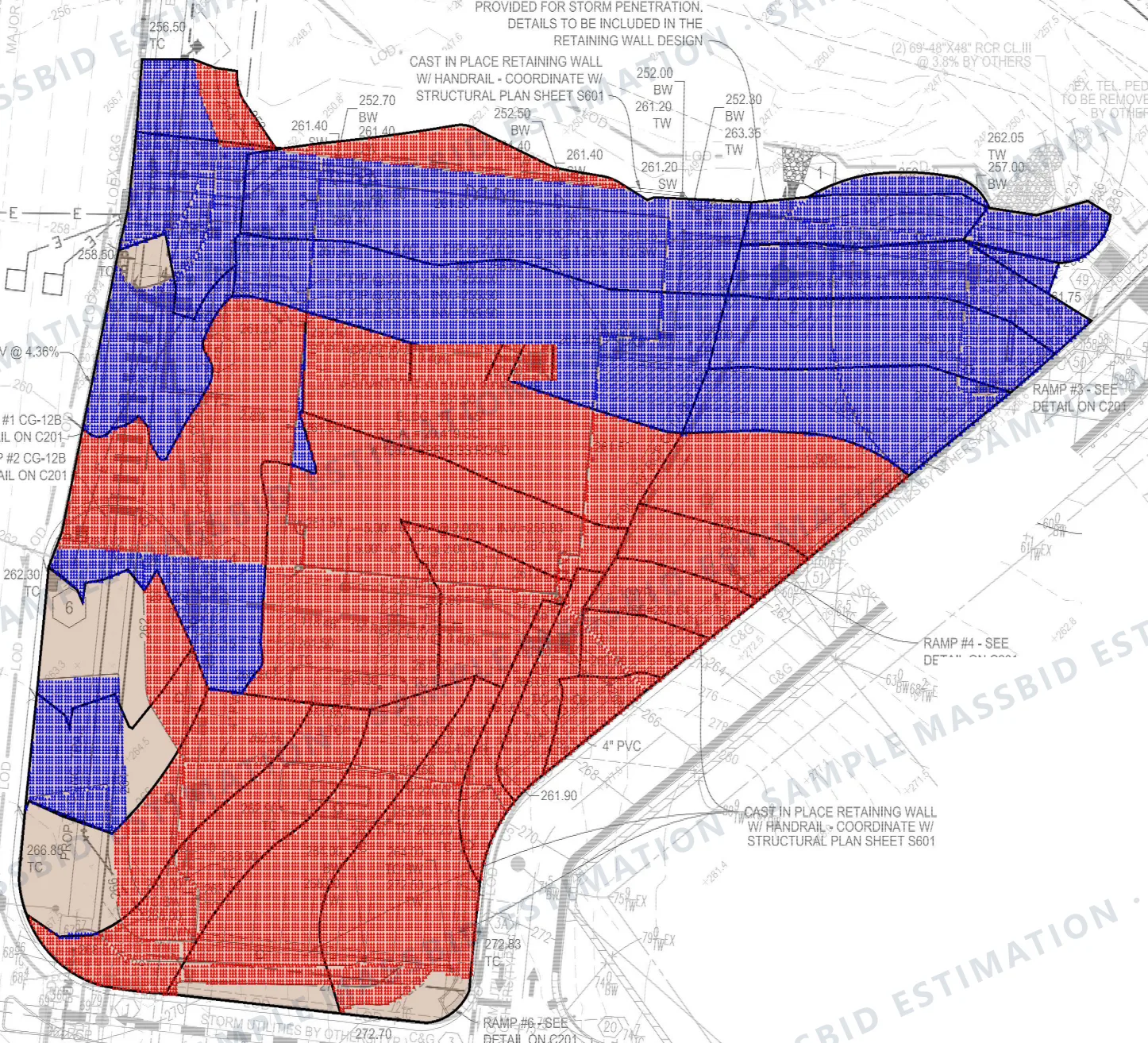
Pages from finished jobs: a public safety building site in Virginia, a fuel station site in Michigan and a commercial building in Texas. Client names, street names and title blocks are removed; the quantities are as delivered. Click any page to enlarge.
Cut and fill plan
Cut and fill takeoff shaded on the grading plan
Protects you fromA balanced total that hides a long haul across the site.
Volume report
Cut and fill volume report by contour
Protects you fromPricing the dig and forgetting the trucks.
Grading areas
Site grading area takeoff with the building pad separated
Protects you fromGrading the pad and the paving to the same elevation.
Priced estimate
Priced sitework estimate: demolition, earthwork and erosion control
Protects you fromErosion control carried as a single allowance.
Every estimate is built to the client's own specification, so yours may be laid out differently. To see a past project in your own trade, ask for an example. Examples are finished work for other projects, not an estimate of yours; for pricing on your own job, send the civil drawings for a free quote.
A real site, by division
Sitework cost by CSI division
Division costs from one finished site estimate: a public safety building site in Virginia of about 112,800 square feet of site area, estimated as a site-only package.
Trade cost came to $4,544,164, or $40.29 per square foot of site. Earthwork itself was under 7 percent of that. Paving and exterior improvements made up two thirds, which is why an excavation bid and a full site bid are very different numbers.
Figures are from the delivered estimate, before overhead and profit, insurance, contingency and tax. They are specific to that project and are shown to illustrate how a site estimate is broken down, not as a price guide.
Real jobs, not a price list. Each figure comes from one project, priced for its own ZIP code and that client's wages, overhead and profit. Prices change by region and over time. Yours will be priced for your location.
| Division | Cost | Per sq ft of site |
|---|---|---|
| 01 General requirements | $959,088 | $8.50 |
| 02 Existing conditions and demolition | $23,562 | $0.21 |
| 31 Earthwork | $301,580 | $2.67 |
| 32 Exterior improvements | $2,999,800 | $26.60 |
| 33 Utilities | $260,133 | $2.31 |
| Total trade cost | $4,544,164 | $40.29 |
Building somewhere else? See figures from jobs in Texas, California, Florida and other service areas.
Full sample
Read a full sample, page by page
Earthwork, from a finished job: a childcare center site in Texas. Open it full screen, scroll through all 2 pages and zoom in on any line.
This is one real job, shown as an example. It was built to that client's own specification: their wage rates, labor style, type of pricing, and overhead and profit. Prices also change by region and over time, so yours will be priced for your location.
Want a current sample in your own trade or specialty, or have a question? Use the contact form, email [email protected] or call (832) 356-4237.
Who it is for
Excavation estimating for site contractors, general contractors and developers
Excavation and grading contractors
Cut, fill and net yardage with a report you can price from, and a shaded plan to show the crew where the dirt moves.
Commercial estimatingSite and utility contractors
Storm, sanitary and water lines by size and depth, structures counted, with trench excavation and bedding worked out.
MEP estimatingPaving and concrete contractors
Asphalt and concrete paving by section, curb and gutter, sidewalks, striping and base course, each as its own line.
GC estimatingGeneral contractors and developers
An independent site number to check a sub quote, or an early earthwork budget before the civil drawings are final.
Preliminary estimating
Earthwork and site scopes we take off
- Mass excavation
- Cut and fill
- Import and export
- Topsoil stripping
- Building pads
- Trench excavation and backfill
- Detention and retention basins
- Erosion and sediment control
- Asphalt and concrete paving
- Curb, gutter and sidewalk
- Storm, sanitary and water utilities
- Site demolition and clearing
Pricing data
Where the prices come from
Quantities are priced from our own pricing database, built with local vendors across the United States. The estimator enters the project's ZIP code and gets current material prices for that market.
Material prices change from region to region and from month to month, so a price book or a national average is out of date before the bid goes in.
Priced by ZIP code
Current local material prices for the place the job is built, not a national average.
Updated by vendors
Local vendors update their prices in the database as they change.
Labor as you bid it
Union, open shop, or Davis-Bacon and prevailing wage rates with fringes.
How it works
From civil drawings to a finished earthwork estimate
Send the civil set
Existing and proposed grading plans, utility and paving plans, the geotechnical report, specifications and addenda. CAD files help where you have them.
Free quote
We review the set and reply with a quote and a delivery date, usually within about 20 minutes.
Model, take off, price and review
The surfaces are built and the volumes calculated; erosion control, paving and utilities are taken off. A separate QA team checks the quantities, then the priced estimate.
Delivery and revisions
The report, shaded plan and workbook typically arrive within 24 to 48 hours. Grading revisions and addenda are handled free, with no time limit.
The work is done in-house by more than 20 estimators, typically with 7 to 10 years of industry experience.
What it costs
Excavation estimating prices
- Earthwork only
- From $199. Simple scopes typically run $100 to $250.
- Full site package
- Typically $200 to $500. Large or complex sites are quoted individually.
- Monthly plan
- From $1,499 for 10 to 15 projects, for contractors who bid every week.
Every job is quoted individually from the drawings, and the quote is free. See all pricing
After delivery
An editable Excel workbook and free revisions
- Formulas built in
An Excel workbook you can change yourself
The estimate arrives as an editable Excel workbook with the formulas built in. Change a quantity, a rate or a markup and every total follows. Move overhead and profit from 25% to 30% and the whole bid recalculates on the spot.
- No waiting
Adjust your bid at the last minute
If something changes just before the deadline, you do not have to send the estimate back and wait. Open the workbook, change the number and submit. The control stays with you.
- Priority turnaround
Free revisions, with no limit
Addenda, scope changes and pricing updates are all free, however many times you come back, and there is no time limit. Revisions are handled on priority and typically come back within an hour to a few hours.
Questions
Excavation estimating FAQ
It is the takeoff and pricing of a project's earthwork and site work. Cut and fill volumes are calculated from the existing and proposed grades, and clearing, erosion control, paving and underground utilities are measured from the civil drawings. Labor, equipment and material costs are then applied to produce an estimate a contractor can bid from.
The existing ground and the proposed ground are each built as a surface from the contours and spot elevations on the grading plan. The volume between the two surfaces is calculated: where the proposed surface is lower it is cut, and where it is higher it is fill. The result is reported in cubic yards with the net import or export.
Cut is soil removed to reach the design grade. Fill is soil placed to reach it. If a site has more cut than fill, the surplus is exported, hauled off and disposed of. If it has more fill than cut, the shortfall is imported. On one site we estimated, 6,367 cubic yards of cut against 3,436 of fill left about 2,931 cubic yards to export.
Yes, where you or the geotechnical report give the factors. Topsoil strip depth, pavement and slab sections, and compaction or swell factors are applied and stated in the report. If none are given, the volumes are reported as bank measure and that is noted, so you can apply your own.
The civil drawings with existing and proposed grades, the paving and utility plans, the geotechnical report if there is one, and the specifications. CAD files of the surfaces speed the work up but are not required; contours and spot elevations on a PDF are enough.
Yes. Storm, sanitary and water lines are measured by size with structures counted. Paving is taken off by section, with curb, sidewalk and striping. Erosion and sediment control is itemized: silt fence, inlet protection, construction entrance and the rest, each as its own line.
An earthwork takeoff starts at $199, and simple scopes typically run $100 to $250. A full site package typically runs $200 to $500, and large or complex sites are quoted individually. The quote is free and usually comes back in about 20 minutes.
Yes. This page shows a full sample from a finished job (earthwork, for a childcare center site in Texas), which you can open full screen and read page by page. It was built to that client's own specification, so the wage rates, pricing and overhead and profit are theirs. Ask us for a current sample in your own trade.
From our own pricing database, built with local vendors across the United States. An estimator enters the project's ZIP code and gets current material prices for that market, and vendors update their prices as they change. Labor is priced as union or open shop, or at Davis-Bacon rates with fringes on government work.
Yes. The estimate is delivered as an editable Excel workbook with the formulas built in. Change any quantity, rate or markup and the whole estimate recalculates. If overhead and profit was set at 25% and you want 30%, change that one cell and every total updates, so you can adjust your number minutes before the bid is due without sending it back to us.
As many as you need. Every revision is free, including addenda, scope changes and pricing updates, however many times you come back, and there is no time limit. Revisions are handled on priority and are typically returned within an hour to a few hours, depending on the size of the change.
Most earthwork takeoffs and site estimates are delivered within 24 to 48 hours of receiving the civil drawings. Very large sites are given a delivery date with the quote.
Because building surfaces and checking them takes hours a site contractor rarely has in bid week, and the cost of a wrong yardage is paid in trucks. Outsourcing gives a contractor a calculated, checked volume report in a day or two and lets them bid more sites with the same staff.
Related services and service areas
Have a site to bid? Send the civil drawings.
Free quote in about 20 minutes. Cut and fill volumes and a priced site estimate typically in 24 to 48 hours, with free revisions with no limit. Based in Houston and estimating earthwork and site work in all 50 states.