For demolition and remodeling contractors
Demolition estimating and takeoff services
Every wall, ceiling, floor, fixture and system to be removed, measured from the demolition plans, with debris volume, hauling and disposal priced.
- Selective, structural and site demo
- Debris volume and dumpsters
- 24 to 48 hours
In short
What demolition estimating covers
Demolition estimating is the takeoff and pricing of everything that has to be removed before new work can start: interior partitions, ceilings, flooring, doors, fixtures, mechanical, electrical and plumbing systems, facade panels, structure and site paving. Each item is measured or counted from the demolition plans, converted to debris volume and weight, and priced with labor, equipment, hauling and disposal. MassBid Estimation prepares selective, interior, structural and site demolition takeoffs and estimates for demolition contractors, remodelers and general contractors, typically in 24 to 48 hours.
- Scope
- Interior and selective demolition, MEP removal, facade and structural demolition, site demolition, disposal
- CSI division
- 02 Existing Conditions: 02 41 13 selective site demolition, 02 41 16 structure demolition, 02 41 19 selective demolition
- You send
- Demolition plans, existing drawings, the new-work plans, MEP demolition sheets, specs and addenda
- You get
- Marked-up demolition plans, a priced workbook by floor or phase, and debris volume and weight
- Turnaround
- 24 to 48 hours on most projects
- Checked by
- A separate QA team, twice on every job
- Coverage
- All 50 states, priced to the project's ZIP code
- Quote
- Free, usually back in about 20 minutes
Wednesday · 11:20 AM
The demolition plan shows dashed lines. It does not show how high the walls are, what is above the ceiling or where the debris goes.
Demolition drawings are the thinnest sheets in a set. Walls to be removed are dashed, a keynote says “remove ceiling in its entirety,” and the mechanical and electrical removals are on sheets a demolition bidder may never be sent.
The quantity is only half of a demolition price. The other half is getting it out of the building: debris volume, weight, the number of dumpsters, the haul and the tipping fee. A takeoff that stops at square feet leaves that half to a guess.
Four ways a demolition bid loses money
01 · The debris
Hauling and disposal priced as a lump sum
Disposal is often the largest single line on a demolition job. Without a volume and a weight there is no way to count dumpsters or loads.
What changes
Removed material is converted to cubic yards and tons, with a void factor, and the dumpster count is stated.
02 · The systems
MEP removal left off because it is on other sheets
Ductwork, piping, fixtures, devices and wiring to be removed are shown on the mechanical, plumbing and electrical demolition sheets.
What changes
MEP demolition is taken off floor by floor: duct and pipe in linear feet, devices and equipment by count.
03 · The unknowns
Heights and construction assumed without saying so
Wall heights, ceiling types and what a partition is made of are frequently not on the demolition plan at all.
What changes
Where the drawings are silent, the assumption is written on the line so it can be confirmed before bid.
04 · The repairs
Patching, protection and what stays
Selective demolition means working around what remains: protecting it, sawcutting to it and patching what is left behind.
What changes
Protection, sawcutting, patch-and-repair and surface preparation for new finishes are each their own line.
Then and now
What has changed in demolition estimating
Demolition used to be priced from a walk-through and a price per square foot. Four things have changed that.
Disposal costs more
Tipping fees, trucking and fuel have made hauling and disposal a larger share of the bid. Volume and weight have to be calculated, not assumed.
Diversion and recycling requirements
Many jurisdictions and owners require a share of demolition debris to be recycled. Concrete, metal and mixed debris have to be quantified separately to price it.
More conversions and adaptive reuse
Offices converted to apartments and retail refitted for new tenants are selective demolition on a large scale, with the structure and sometimes the facade partly kept.
Occupied buildings
Much demolition now happens beside tenants who are staying. Temporary protection, phasing and working hours are real costs that belong in the estimate.
Real demolition work
Sample demolition takeoffs and estimates
Pages from finished jobs: a six-story office building converted to apartments in Illinois, a tenant space in Maryland and a pair of seven-story office buildings in Virginia. Client names, street names and title blocks are removed; the quantities are as delivered. Click any page to enlarge.
Interior demolition
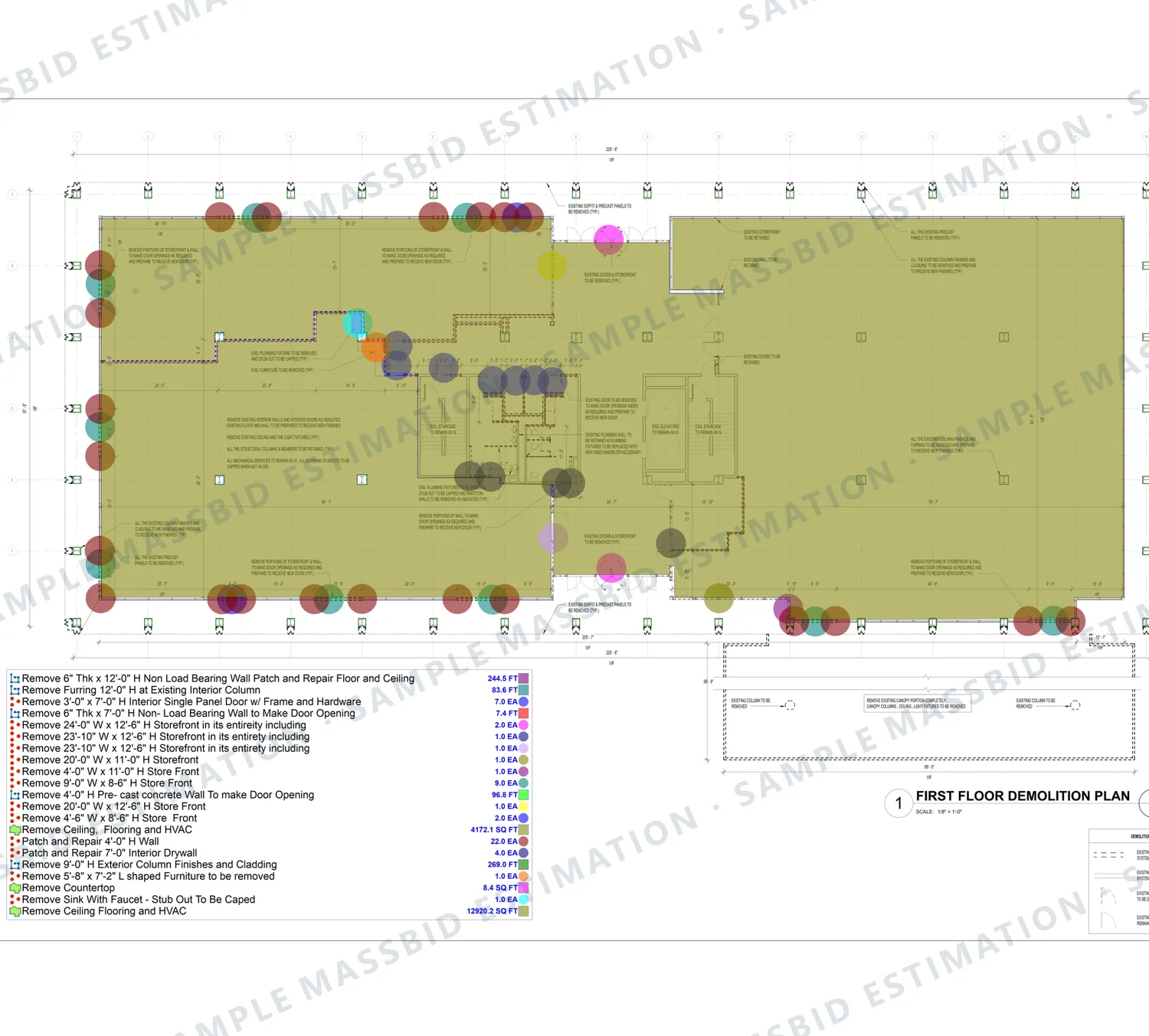
Interior demolition takeoff: walls, storefront, flooring and ceiling on one floor
Protects you fromA floor priced at one rate per square foot.
Facade
Facade demolition takeoff: precast panels and exterior glazing
Protects you fromPanels counted without the crane to remove them.
Site demolition
Site demolition takeoff: pavement, curb, trees and utilities
Protects you fromSite removals left to the excavator.
Tenant space
Tenant improvement demolition: partitions, doors, casework, ceiling and flooring
Protects you fromA small job priced by eye.
Priced estimate
Priced demolition estimate, item by item
Protects you fromOne number for the whole building.
Every estimate is built to the client's own specification, so yours may be laid out differently. To see a past project in your own trade, ask for an example. Examples are finished work for other projects, not an estimate of yours; for pricing on your own job, send the demolition plans for a free quote.
A real demolition estimate
Demolition cost breakdown for an office-to-apartment conversion
Totals by category from one finished estimate: a six-story office building of about 115,400 square feet in Illinois, stripped to the structure for conversion to apartments, with the surrounding parking lot removed.
Demolition trade cost came to $743,085, about $6.44 per square foot of building with the site work included. Disposal, the crane and the electrical removal allowance together were about 30% of it. With general requirements and markups the suggested bid was $1,078,457. On two other jobs, interior demolition of a small tenant space in Maryland came to $4.47 per square foot, and architectural and MEP demolition of two seven-story office buildings in Virginia to $8.31.
Figures are from the delivered estimates, rounded to the dollar, with related lines combined. They are specific to those projects and are shown to illustrate how a demolition estimate is broken down, not as a price guide.
Real jobs, not a price list. Each figure comes from one project, priced for its own ZIP code and that client's wages, overhead and profit. Prices change by region and over time. Yours will be priced for your location.
| Item | Quantity | Cost |
|---|---|---|
| Site paving, curb, walk and slab removal | $131,518 | |
| Temporary fencing, site utilities and other items | $100,687 | |
| Electrical wiring and fixture removal, allowance | 110,949 SF | $78,774 |
| Disposal and haul-off, allowance | $75,752 | |
| Flooring and wall base removal | 110,949 SF | $71,895 |
| Precast wall panels and openings | 210 panels | $65,515 |
| Crane allowance, 120-ton, 30 days | $65,320 | |
| Ceiling removal | 110,949 SF | $35,504 |
| Partitions, shaft walls and column furring | 47,134 SF | $34,374 |
| Drywall preparation for new finishes | 35,623 SF | $23,084 |
| Doors, plumbing and restroom fixtures | $19,602 | |
| Tree removal | 36 EA | $14,920 |
| Exterior windows | 504 EA | $13,104 |
| Storefront removal | 18 EA | $13,036 |
| Demolition trade cost | $743,085 |
Building somewhere else? See figures from jobs in Texas, California, Florida and other service areas.
Full sample
Read a full sample, page by page
Demolition, from a finished job: a education building, 8,260 sq ft in Maryland. Open it full screen, scroll through all 3 pages and zoom in on any line.
This is one real job, shown as an example. It was built to that client's own specification: their wage rates, labor style, type of pricing, and overhead and profit. Prices also change by region and over time, so yours will be priced for your location.
Want a current sample in your own trade or specialty, or have a question? Use the contact form, email [email protected] or call (832) 356-4237.
Who it is for
Demolition estimating for demolition contractors, remodelers and general contractors
Demolition contractors
Quantities by floor or phase, debris volume and weight, and a priced estimate for each bid.
Commercial estimatingRemodeling and tenant improvement contractors
Selective demolition taken off with the new work, so the fit-out bid starts from what is really there.
Remodeling estimatingSitework contractors
Pavement, curb, utilities and structures to be removed, ahead of the earthwork.
Earthwork estimatingGeneral contractors
An independent Division 02 number to check a demolition quote, or to carry when none comes in.
GC estimating
Demolition scopes we take off
- Interior and selective demolition
- Partition and ceiling removal
- Flooring removal and surface prep
- Doors, windows and storefront
- Fixtures, casework and equipment
- Mechanical and ductwork removal
- Electrical and plumbing removal
- Facade and precast panels
- Structural demolition
- Pavement, curb and sidewalk
- Trees, poles and site utilities
- Hauling and disposal
Pricing data
Where the prices come from
Quantities are priced from our own pricing database, built with local vendors across the United States. The estimator enters the project's ZIP code and gets current material prices for that market.
Material prices change from region to region and from month to month, so a price book or a national average is out of date before the bid goes in.
Priced by ZIP code
Current local material prices for the place the job is built, not a national average.
Updated by vendors
Local vendors update their prices in the database as they change.
Labor as you bid it
Union, open shop, or Davis-Bacon and prevailing wage rates with fringes.
How it works
From demolition plans to a finished estimate
Send the drawings
Demolition plans, existing-condition drawings, the new-work plans, MEP demolition sheets, the Division 02 specification and addenda. Site photos help where drawings are thin.
Free quote
We review the set and reply with a quote and a delivery date, usually within about 20 minutes.
Measure, count, price and two QA reviews
Removals are measured or counted by floor and compared against the new-work plans; debris volume and weight are calculated. A separate QA team checks the quantities, then the priced estimate.
Delivery and revisions
The package typically arrives within 24 to 48 hours. Addenda and revisions are free, with no limit and no time limit, and are handled on priority.
The work is done in-house by more than 20 estimators, typically with 7 to 10 years of industry experience.
What it costs
Demolition estimating prices
- Single project
- From $199. Simple scopes typically run $100 to $250.
- Larger buildings
- Typically $200 to $500. Large, multi-story or phased demolition is quoted individually.
- Monthly plan
- From $1,499 for 10 to 15 projects, for contractors who bid every week.
Every job is quoted individually from the drawings, and the quote is free. See all pricing
After delivery
An editable Excel workbook and free revisions
- Formulas built in
An Excel workbook you can change yourself
The estimate arrives as an editable Excel workbook with the formulas built in. Change a quantity, a rate or a markup and every total follows. Move overhead and profit from 25% to 30% and the whole bid recalculates on the spot.
- No waiting
Adjust your bid at the last minute
If something changes just before the deadline, you do not have to send the estimate back and wait. Open the workbook, change the number and submit. The control stays with you.
- Priority turnaround
Free revisions, with no limit
Addenda, scope changes and pricing updates are all free, however many times you come back, and there is no time limit. Revisions are handled on priority and typically come back within an hour to a few hours.
Questions
Demolition estimating FAQ
It is the takeoff and pricing of everything to be removed from a building or site. Walls, ceilings, floors, fixtures, mechanical and electrical systems, structure and paving are measured or counted from the demolition plans, converted to debris volume and weight, and priced with labor, equipment, hauling and disposal.
Partition removal by thickness and height, ceiling and flooring by area, doors, windows and storefront by count, fixtures and casework, ductwork, piping and electrical devices, structural and facade elements, site paving and utilities, sawcutting and patching, protection of what stays, and debris hauling and disposal.
Selective demolition removes parts of a building while the rest stays in use or is kept for the new work, as in a tenant improvement or a conversion. Total or structure demolition takes the whole building down. Selective work is measured item by item; total demolition is usually measured by building volume and material type.
Each removed item's volume is calculated and a void factor is added for how loosely debris sits in a container; weight is worked out by material. On one 8,259 square foot tenant space we estimated, that came to 68 cubic yards, 82 with the void factor, about 34 tons and five 17-yard loads.
Yes. Ductwork and piping are measured in linear feet and devices, fixtures and equipment are counted, floor by floor, from the MEP demolition sheets.
It depends on how much is removed and what it is. On three jobs we estimated, interior demolition of a tenant space was $4.47 per square foot, an office building stripped for conversion with its site was about $6.44, and architectural and MEP demolition of two office buildings was $8.31, all before markups.
The item is priced on a stated assumption, written on the line, and the open questions are listed with the estimate. Site photos or a walk-through report can be used where they are available.
Abatement is priced only where a survey or report gives quantities. Without one it is excluded and noted, because it cannot be measured from drawings.
Yes. This page shows a full sample from a finished job (demolition, for a education building, 8,260 sq ft in Maryland), which you can open full screen and read page by page. It was built to that client's own specification, so the wage rates, pricing and overhead and profit are theirs. Ask us for a current sample in your own trade.
From our own pricing database, built with local vendors across the United States. An estimator enters the project's ZIP code and gets current material prices for that market, and vendors update their prices as they change. Labor is priced as union or open shop, or at Davis-Bacon rates with fringes on government work.
Yes. The estimate is delivered as an editable Excel workbook with the formulas built in. Change any quantity, rate or markup and the whole estimate recalculates. If overhead and profit was set at 25% and you want 30%, change that one cell and every total updates, so you can adjust your number minutes before the bid is due without sending it back to us.
As many as you need. Every revision is free, including addenda, scope changes and pricing updates, however many times you come back, and there is no time limit. Revisions are handled on priority and are typically returned within an hour to a few hours, depending on the size of the change.
A single project starts at $199, and simple scopes typically run $100 to $250. Larger buildings typically run $200 to $500, and large, multi-story or phased demolition is quoted individually. The quote is free and usually comes back in about 20 minutes.
Yes. Every estimate is built to the client's own specification. Send your unit prices, crew rates or template and the package is returned that way, or order quantities alone and price them yourself.
Related services and service areas
Have a demolition bid due? Send the plans.
Free quote in about 20 minutes. Demolition takeoffs and estimates typically in 24 to 48 hours, built to your format, with free revisions with no limit. Based in Houston and estimating demolition in all 50 states.