For waterproofing, insulation and envelope contractors
Thermal and moisture protection estimating services
Building wrap, insulation, flashing, sealants and roofing measured from the plans, elevations and details, and priced line by line.
- CSI Division 07
- Flashing and sealant by the foot
- 24 to 48 hours
In short
What thermal and moisture protection estimating covers
Thermal and moisture protection estimating is the takeoff and pricing of CSI Division 07, the materials that keep water, air and heat where they belong: waterproofing and dampproofing, insulation, air and weather barriers, building wrap, flashing, joint sealants, firestopping and roofing. Areas are measured from the plans and elevations, and flashing and sealant are measured in linear feet at every opening and joint. MassBid Estimation prepares Division 07 takeoffs and estimates for waterproofing, insulation and envelope contractors, general contractors and suppliers, typically in 24 to 48 hours.
- Scope
- Waterproofing, insulation, air and weather barriers, flashing, sealants, firestopping, roofing
- CSI division
- 07: 07 10 waterproofing, 07 20 insulation, 07 25 weather barriers, 07 60 flashing, 07 90 sealants
- You send
- Plans, exterior elevations, wall sections and details, roof plan, the Division 07 spec and addenda
- You get
- Marked-up plans and elevations, a quantity or priced workbook, and a material list
- Turnaround
- 24 to 48 hours on most projects
- Checked by
- A separate QA team, twice on every job
- Coverage
- All 50 states, priced to the project's ZIP code
- Quote
- Free, usually back in about 20 minutes
Monday · 10:40 AM
The wall area took ten minutes. The flashing at 110 windows is in a detail on sheet A8.
Division 07 is the least visible scope on a set of drawings. A window is drawn once on the elevation; the sill pan, the flashing tape at the jambs, the head flashing and two beads of sealant around it are drawn once in a detail and never again.
So the areas get measured and the linear items get an allowance. On an apartment building with hundreds of openings, the linear items are where the money is.
Four ways a Division 07 bid loses money
01 · The openings
Flashing and sealant at openings covered by an allowance
Every window, door and storefront has a sill, a head and two jambs, each with its own flashing and sealant. Multiplied by the opening count, it is a large number.
What changes
Sill, head and jamb lengths are taken per opening type and each flashing and sealant is listed in linear feet.
02 · The details
Quantities taken from plans without reading the details
Flashing width, lap, membrane height and sealant joint size are only in the wall sections and details. The plan shows where; the detail shows how much.
What changes
Each line carries the detail reference it was taken from, so the quantity can be traced.
03 · The wall area
Building wrap priced on floor area
Weather barrier covers the wall, not the floor. It has to be measured on the elevations, including gables and returns the floor plan does not show.
What changes
Wrap, rainscreen and wall insulation are measured on the elevations by wall area.
04 · The penetrations
Pipe, duct and conduit penetrations nobody counted
Each penetration through a rated or exterior wall is a seal. They sit on the mechanical, plumbing and electrical sheets, not the architectural ones.
What changes
Penetrations are counted by size from the MEP sheets and added to the sealant and firestopping scope.
Then and now
What has changed in thermal and moisture protection
The envelope used to mean felt paper, batt insulation and a tube of caulk. Four things have changed what a Division 07 takeoff has to cover.
Continuous air barriers are required
Energy codes now call for a continuous air barrier on most commercial buildings. Sheathing joints, corners and every opening have to be taped or sealed, and each is a quantity.
Integrated sheathing and tape systems
Sheathing with a factory-applied barrier moves the work from wrapping a wall to taping seams and flashing openings. The takeoff is in rolls of tape by width, not squares of wrap.
Continuous insulation and rainscreens
Exterior continuous insulation and drainage mats behind cladding are now common, adding layers to the wall that an older unit price never included.
More of the cost is in the linear items
Self-adhered membranes, pre-formed flashings and high-performance sealants cost more per foot than the materials they replaced, so openings and joints carry a larger share of the bid.
Real Division 07 work
Sample thermal and moisture protection takeoffs
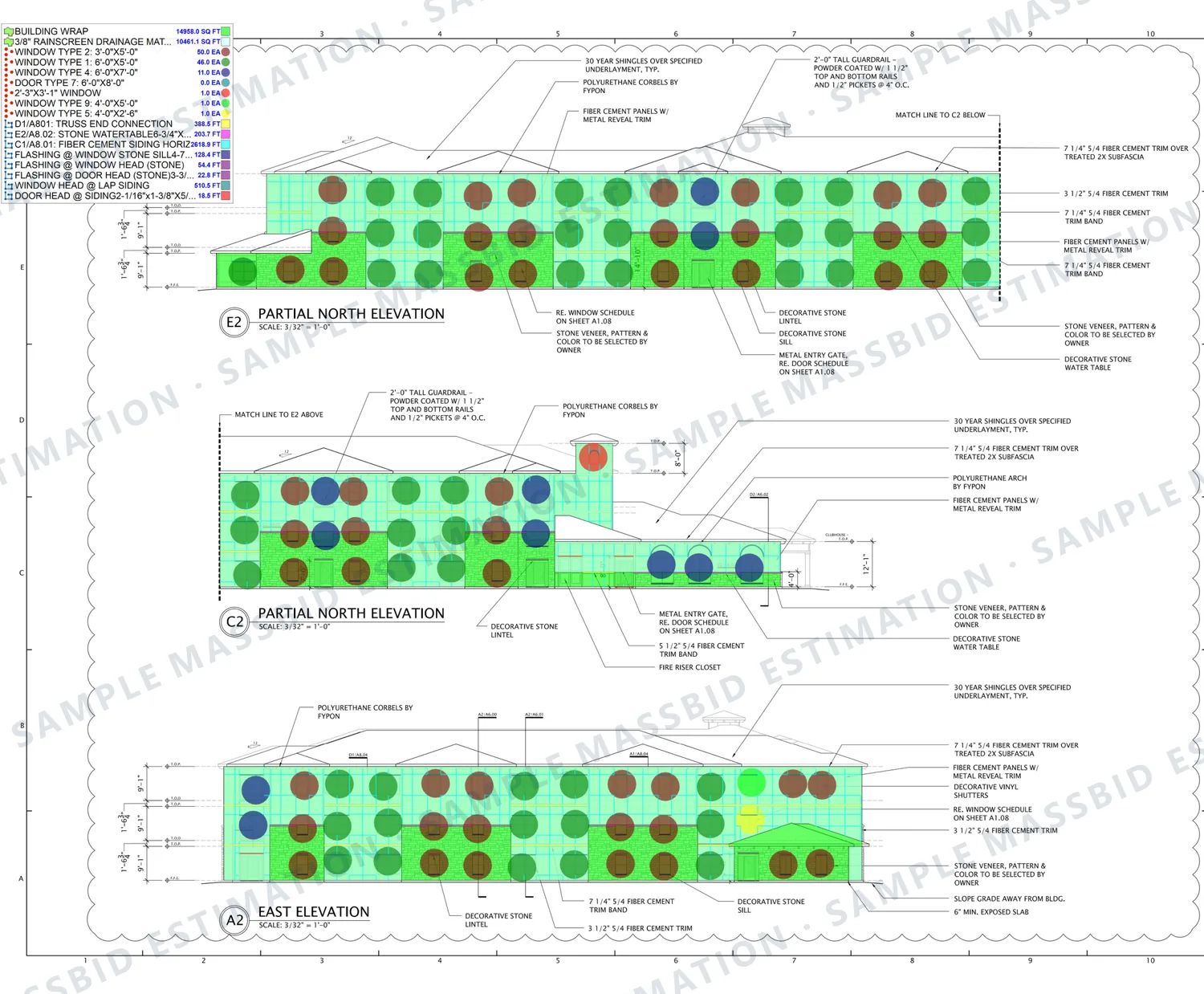
Pages from finished jobs: a three-story apartment community in Texas, an operations building in New Mexico and a five-story apartment building in Minnesota. Client names, addresses and title blocks are removed; the quantities are as delivered. Click any page to enlarge.
Weather barrier
Building wrap, rainscreen and flashing takeoff on the elevations
Protects you fromWeather barrier priced from the floor area.
Sill sealer and tape
Sill sealer and self-adhered flashing tape takeoff on a floor plan
Protects you fromSill sealer ordered by guesswork.
Flashing
Flashing tape and metal flashing takeoff on building elevations
Protects you fromThe roof-to-wall joint nobody measured.
Priced estimate
Priced Division 07 estimate: roof assembly and opening flashings
Protects you fromA square-foot allowance for the whole envelope.
Every estimate is built to the client's own specification, so yours may be laid out differently. To see a past project in your own trade, ask for an example. Examples are finished work for other projects, not an estimate of yours; for pricing on your own job, send the drawings for a free quote.
A real Division 07 estimate
Thermal and moisture protection cost breakdown for an apartment building
Line totals from one finished estimate: a five-story apartment building in Minnesota of about 142,700 square feet, with a 36,000 square foot TPO roof.
Division 07 trade cost came to $461,269, or $3.23 per square foot of building. The roof was about 71% of that, and the tapered insulation cost more than the membrane above it. Flashing, self-adhered membrane and sealant at balcony, window and storefront openings came to $134,992, or 29%, on roughly 13,000 linear feet of opening perimeter. With general requirements and markups the suggested bid was $679,906.
Figures are from the delivered estimate, labor plus material, rounded to the dollar, with related lines combined. They are specific to that project and are shown to illustrate how a Division 07 estimate is broken down, not as a price guide.
Real jobs, not a price list. Each figure comes from one project, priced for its own ZIP code and that client's wages, overhead and profit. Prices change by region and over time. Yours will be priced for your location.
| Item | Quantity | Cost |
|---|---|---|
| Tapered roof insulation, R-30 | 36,176 SF | $92,812 |
| Flashing and sealant at window openings | 9,292 LF | $79,596 |
| Roof protection board | 36,176 SF | $69,241 |
| 60 mil TPO roof membrane | 36,176 SF | $66,767 |
| Flashing and sealant at balcony openings | 2,952 LF | $48,772 |
| Vapor retarder at roof | 36,176 SF | $32,073 |
| Roof accessories: hatch, walkway pads, guardrail, scuppers, soffit | $24,561 | |
| Parapet cap, drip edge and coping | 3,107 LF | $23,779 |
| Vegetated roof modules and slip sheet | 1,715 SF | $11,054 |
| Flashing and sealant at storefront openings | 709 LF | $6,624 |
| Roof membrane at parapet | 3,253 SF | $5,990 |
| Division 07 trade cost | $461,269 |
Building somewhere else? See figures from jobs in Texas, California, Florida and other service areas.
Full sample
Read a full sample, page by page
We do not have a sample for exactly this scope online yet. This is the closest one. Roofing and sheet metal, from a finished job: a drive-through building in Oklahoma. Open it full screen, scroll through all 3 pages and zoom in on any line.
This is one real job, shown as an example. It was built to that client's own specification: their wage rates, labor style, type of pricing, and overhead and profit. Prices also change by region and over time, so yours will be priced for your location.
Want a current sample in your own trade or specialty, or have a question? Use the contact form, email [email protected] or call (832) 356-4237.
Who it is for
Division 07 estimating for envelope contractors, general contractors and suppliers
Waterproofing and envelope contractors
Weather barrier, flashing and sealant quantities for each bid, traced to the detail they came from.
Commercial estimatingRoofing contractors
Membrane, insulation, coping and edge metal where roofing is your part of Division 07.
Roofing estimatingGeneral contractors
An independent Division 07 number to check several small quotes against, or to carry when a trade does not bid.
GC estimatingBuilding-material suppliers
Quantities only, in the units you sell: rolls of tape and sill sealer, pieces of flashing by cut length, tubes of sealant.
Supplier takeoffs
Division 07 scopes we take off
- Waterproofing and dampproofing
- Building wrap and air barriers
- Rainscreen and drainage mat
- Wall and roof insulation
- Vapor retarders
- Flashing tape and self-adhered membrane
- Sheet-metal flashing and trim
- Sill sealer
- Joint sealants and backer rod
- Firestopping and penetration seals
- Roof membrane and coping
- Metal wall and soffit panels
Pricing data
Where the prices come from
Quantities are priced from our own pricing database, built with local vendors across the United States. The estimator enters the project's ZIP code and gets current material prices for that market.
Material prices change from region to region and from month to month, so a price book or a national average is out of date before the bid goes in.
Priced by ZIP code
Current local material prices for the place the job is built, not a national average.
Updated by vendors
Local vendors update their prices in the database as they change.
Labor as you bid it
Union, open shop, or Davis-Bacon and prevailing wage rates with fringes.
How it works
From drawings to a finished Division 07 estimate
Send the drawings
Plans, exterior elevations, wall sections and details, the roof plan, the Division 07 specification and addenda, plus your own template or pricing.
Free quote
We review the set and reply with a quote and a delivery date, usually within about 20 minutes.
Measure, count, price and two QA reviews
Wall and roof areas are measured; flashing, tape and sealant are measured per opening and joint; penetrations are counted. A separate QA team checks the quantities against the details, then the priced estimate.
Delivery and revisions
The package typically arrives within 24 to 48 hours. Addenda and revisions are free, with no limit and no time limit, and are handled on priority.
The work is done in-house by more than 20 estimators, typically with 7 to 10 years of industry experience.
What it costs
Thermal and moisture protection estimating prices
- Single project
- From $199. Simple scopes typically run $100 to $250.
- Larger buildings
- Typically $200 to $500. Large or multi-building projects are quoted individually.
- Monthly plan
- From $1,499 for 10 to 15 projects, for contractors and suppliers who bid every week.
Every job is quoted individually from the drawings, and the quote is free. See all pricing
After delivery
An editable Excel workbook and free revisions
- Formulas built in
An Excel workbook you can change yourself
The estimate arrives as an editable Excel workbook with the formulas built in. Change a quantity, a rate or a markup and every total follows. Move overhead and profit from 25% to 30% and the whole bid recalculates on the spot.
- No waiting
Adjust your bid at the last minute
If something changes just before the deadline, you do not have to send the estimate back and wait. Open the workbook, change the number and submit. The control stays with you.
- Priority turnaround
Free revisions, with no limit
Addenda, scope changes and pricing updates are all free, however many times you come back, and there is no time limit. Revisions are handled on priority and typically come back within an hour to a few hours.
Questions
Thermal and moisture protection estimating FAQ
It is CSI MasterFormat Division 07: the materials that keep water, air and heat out of or inside a building. It includes waterproofing and dampproofing, insulation, air and weather barriers, roofing, flashing and sheet metal, joint sealants and firestopping.
Wall and roof areas for weather barrier, insulation and membrane; flashing, flashing tape and sealant in linear feet at every opening and joint; sill sealer under exterior walls; penetrations counted by size; and coping, edge metal and roof accessories.
Roofing is one part of Division 07. A thermal and moisture protection estimate also covers the walls and openings: building wrap, air barrier, insulation, flashing and sealants. Roofing contractors usually need only the roof; envelope contractors and general contractors need the whole division.
Per opening. The sill, head and jamb lengths of each window type are multiplied by the count, and every flashing and sealant in the detail is listed on its own line. On one apartment building we estimated, that came to 9,292 linear feet of window perimeter.
It depends on the roof and the number of openings. On one five-story apartment building we estimated, Division 07 trade cost was $3.23 per square foot of building before general requirements and markups, with the roof about 71% of it.
Yes. Sealant-only scopes are measured joint by joint: storefront and door perimeters, panel joints, control and expansion joints. On one 61,800 square foot commercial building in Texas, building and site paving joint sealants alone were estimated at $408,926.
Yes. Quantities can be converted to the units you sell, such as 50-foot rolls of sill sealer, 75-foot rolls of flashing tape, 10-foot pieces of metal flashing and cartridges of sealant, with waste included.
A single project starts at $199, and simple scopes typically run $100 to $250. Larger buildings typically run $200 to $500, and large or multi-building projects are quoted individually. The quote is free and usually comes back in about 20 minutes.
Yes. This page shows a full sample from a finished job (roofing and sheet metal, for a drive-through building in Oklahoma), which you can open full screen and read page by page. It is the closest sample we have online for this scope. It was built to that client's own specification, so the wage rates, pricing and overhead and profit are theirs. Ask us for a current sample in your own trade.
From our own pricing database, built with local vendors across the United States. An estimator enters the project's ZIP code and gets current material prices for that market, and vendors update their prices as they change. Labor is priced as union or open shop, or at Davis-Bacon rates with fringes on government work.
Yes. The estimate is delivered as an editable Excel workbook with the formulas built in. Change any quantity, rate or markup and the whole estimate recalculates. If overhead and profit was set at 25% and you want 30%, change that one cell and every total updates, so you can adjust your number minutes before the bid is due without sending it back to us.
As many as you need. Every revision is free, including addenda, scope changes and pricing updates, however many times you come back, and there is no time limit. Revisions are handled on priority and are typically returned within an hour to a few hours, depending on the size of the change.
Yes. Every estimate is built to the client's own specification. Send your template, unit prices or labor rates and the package is returned that way, or order quantities alone.
Because the scope is spread across plans, elevations, sections and details, and reading all of them for every bid is slow. Outsourcing gives a contractor a traced, checked takeoff in a day or two.
Have a Division 07 bid due? Send the drawings.
Free quote in about 20 minutes. Thermal and moisture protection takeoffs and estimates typically in 24 to 48 hours, built to your format, with free revisions with no limit. Based in Houston and estimating in all 50 states.