Austin · Travis, Williamson and Hays counties
Construction estimating services in Austin
Takeoffs and priced estimates for Austin general contractors, subcontractors and suppliers, measured from your drawings and priced to the ZIP code the job is built in.
- Austin, Round Rock, Georgetown, San Marcos
- Apartments, commercial, schools
- 24 to 48 hours
In short
Estimating in Austin at a glance
MassBid Estimation prepares quantity takeoffs and cost estimates for construction projects across the Austin area, from its office in Houston. Every trade on the drawings is measured, priced to the project's ZIP code and checked twice, and the package is typically delivered in 24 to 48 hours. Recent Austin work includes the exterior flashing and window takeoff for a three-story apartment community in southeast Austin, with 455 windows of one type alone.
- Area covered
- Travis, Williamson, Hays and Bastrop counties
- Recent Austin work
- Exterior flashing and window takeoff for a three-story apartment community
- Austin cost drivers
- Limestone to the west, clay to the east, water-quality rules, a stretched labor market
- Prepared in
- Houston, Texas
- Turnaround
- 24 to 48 hours on most projects
- Checked by
- A separate QA team, twice on every job
- Team
- 20+ in-house estimators, typically 7 to 10 years in the trade
- Quote
- Free, usually back in about 20 minutes
Austin · Pre-bid meeting
Interstate 35 splits Austin in two. West of it you dig rock. East of it you fight clay.
Austin sits on a geological line. To the west is Hill Country limestone, where a utility trench is rock excavation. To the east is deep black clay, where a foundation needs piers or a stiffened slab. The same building costs different money on each side.
It is also the most expensive city in Texas to build in, with a labor market stretched by chip plants and data centers. Four things decide whether an Austin estimate holds.
Four things an Austin estimate has to get right
01 · The rock
Limestone west of the interstate
In west Austin, Cedar Park and Dripping Springs, footings, utilities and detention are cut into limestone. Ordinary excavation rates do not apply.
What changes
Rock is separated from soil wherever the geotechnical report shows it, and priced at its own rate.
02 · The clay
Expansive soil to the east
East Austin, Pflugerville, Manor and Hutto sit on clay that swells and shrinks. Soils reports call for select fill, piers or post-tensioned slabs.
What changes
Foundation requirements in the report are taken off with the structural drawings and priced.
03 · The water
Water-quality and impervious cover rules
Over the Edwards Aquifer and in Austin's watersheds, sites need water-quality ponds, filtration and limits on paved area that add structures a typical site does not have.
What changes
Ponds, filtration beds and storm structures are measured from the civil drawings.
04 · The count
Repetition on apartment work
Austin builds apartments by the thousand. On one community we took off, a single window type appeared 455 times. Miss one detail and the error is multiplied by every unit.
What changes
Openings and flashings are counted on every elevation, not multiplied from a typical bay.
Austin submarkets
The Austin area, priced submarket by submarket
Three counties with different ground, different rules and different labor travel.
Central Austin
Downtown, the university area, South Congress and East Austin: towers, mid-rise apartments, renovation and public work on tight sites.
North: Round Rock, Cedar Park and Georgetown
Williamson County: corporate campuses, medical, retail, schools and subdivisions, with rock on the west side.
South: Kyle, Buda and San Marcos
Hays County along Interstate 35: apartments, distribution, retail and university work.
East: Manor, Hutto and Taylor
Semiconductor and industrial growth, with apartments and schools following it, all on clay.
Real Austin work
Sample takeoff from an Austin apartment community
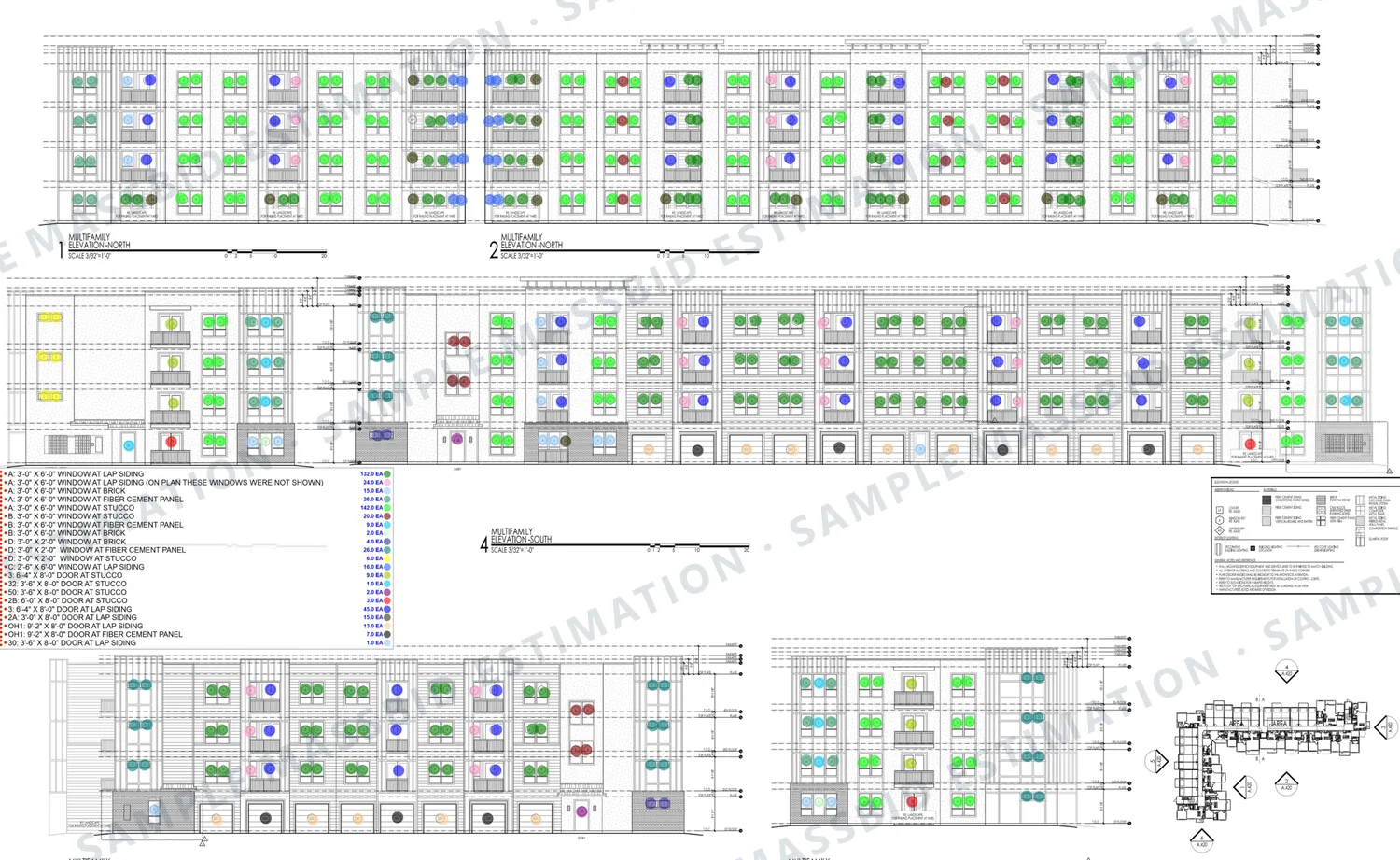
Two pages from one finished job: the exterior flashing and window takeoff for a three-story apartment community in southeast Austin, prepared for a building-materials supplier. The client name, address and title block are removed. Click either page to enlarge.
Elevations
Window and door takeoff on Austin apartment elevations
Protects you fromWindows counted without their cladding.
Floor plan
Metal flashing takeoff on an Austin apartment floor plan
Protects you fromOne flashing profile for every condition.
Every estimate is built to the client's own specification, so yours may be laid out differently. To see a past project in your own trade, ask for an example. Examples are finished work for other projects, not an estimate of yours; for pricing on your own job, send your Austin drawings for a free quote.
Real Austin quantities
What the takeoff counted on an Austin apartment community
The largest lines from the material takeoff we delivered for the apartment community shown above. Flashing is listed in pieces of 10-foot stock, with waste included.
This was a quantity takeoff for a supplier, who applies their own prices, so there are no dollar figures to show. For Austin cost per square foot, the published ranges are in the next table.
Quantities are from the delivered takeoff and include waste. They are specific to that project.
Real jobs, not a price list. Each figure comes from one project, priced for its own ZIP code and that client's wages, overhead and profit. Prices change by region and over time. Yours will be priced for your location.
| Item | Qty | Unit |
|---|---|---|
| Window, 3'-0" × 6'-0", at lap siding | 455 | each |
| Window, 3'-0" × 6'-0", at fiber cement panel | 88 | each |
| Window-head flashing at lap siding | 240 | pieces |
| Window-head flashing at stucco | 202 | pieces |
| Door-head flashing at lap siding | 139 | pieces |
| Flashing, lap siding to balcony slab | 137 | pieces |
| Flashing, panel to foundation | 130 | pieces |
Published market ranges
What building in Austin costs per square foot
Our Austin work so far is quantity takeoffs, so these are the published cost ranges for Austin until we have priced estimates of our own to show.
These are a cost consultant's published ranges for whole buildings, not our estimates. They are useful for checking a budget; a bid still needs quantities measured from the drawings.
Hard construction cost per square foot of gross floor area, second quarter of 2026. Ranges vary with site conditions, specification and market conditions.
Source: Rider Levett Bucknall, North America Quarterly Construction Cost Report, Q2 2026
| Building type | Low | High |
|---|---|---|
| Office, prime | $255 | $425 |
| Office, secondary | $165 | $230 |
| Retail, strip center | $195 | $260 |
| Hotel, three-star | $305 | $450 |
| Hospital | $480 | $680 |
| Warehouse | $75 | $150 |
| Multifamily residential | $185 | $275 |
| Single-family residential | $195 | $520 |
| Elementary school | $280 | $395 |
| High school | $315 | $480 |
Full sample
Read a full sample, page by page
Supplier takeoff: flashing and windows, from a finished job: a three-story apartment community in Texas. Open it full screen, scroll through the page and zoom in on any line.
This is one real job, shown as an example. It was built to that client's own specification: their wage rates, labor style, type of pricing, and overhead and profit. Prices also change by region and over time, so yours will be priced for your location.
Want a current sample in your own trade or specialty, or have a question? Use the contact form, email [email protected] or call (832) 356-4237.
Trades and places
What Austin contractors send us most
Flashing and weather barrier
Every profile and opening, as on the apartments above.
Flashing takeoffsSupplier material takeoffs
Wrap, sealer, adhesive and hardware in order units.
Supplier takeoffsEarthwork
Cut and fill with rock separated from soil.
Earthwork estimatingWindows
Units counted by type, size and wall condition.
Window estimating
Austin-area places we price
- Austin
- Round Rock
- Cedar Park
- Georgetown
- Pflugerville
- San Marcos
- Leander
- Kyle
- Buda
- Hutto
- Taylor
- Manor
- Lakeway
- Dripping Springs
Pricing data
How a Austin project is priced
Quantities are priced from our own pricing database, built with local vendors across the United States. The estimator enters the project's ZIP code and gets current material prices for that part of Austin.
Material prices change from region to region and from month to month, so a price book or a national average is out of date before the bid goes in.
Priced by ZIP code
Current local material prices for the place the job is built, not a national average.
Updated by vendors
Local vendors update their prices in the database as they change.
Labor as you bid it
Union, open shop, or Davis-Bacon and prevailing wage rates with fringes.
How it works
From Austin drawings to a finished estimate
Send the drawings
Plans, specifications and addenda, with the project address or ZIP code, the bid date and any bid form or template you have to fill in.
Free quote
We review the set and reply with a quote and a delivery date, usually within about 20 minutes.
Takeoff, pricing and two QA reviews
Quantities are measured on the drawings and priced to the project's ZIP code. A separate QA team checks the quantities against the plans, then the priced estimate.
Delivery and revisions
The package typically arrives within 24 to 48 hours. Addenda and revisions are free, with no limit and no time limit, and are handled on priority.
The work is done in-house by more than 20 estimators, typically with 7 to 10 years of industry experience.
What it costs
Estimating prices for Austin projects
- Single project
- From $199. Simple scopes typically run $100 to $250.
- Larger buildings
- Typically $200 to $500. Large or multi-building projects are quoted individually.
- Monthly plan
- From $1,499 for 10 to 15 projects, for contractors who bid every week.
Every job is quoted individually from the drawings, and the quote is free. See all pricing
After delivery
An editable Excel workbook and free revisions
- Formulas built in
An Excel workbook you can change yourself
The estimate arrives as an editable Excel workbook with the formulas built in. Change a quantity, a rate or a markup and every total follows. Move overhead and profit from 25% to 30% and the whole bid recalculates on the spot.
- No waiting
Adjust your bid at the last minute
If something changes just before the deadline, you do not have to send the estimate back and wait. Open the workbook, change the number and submit. The control stays with you.
- Priority turnaround
Free revisions, with no limit
Addenda, scope changes and pricing updates are all free, however many times you come back, and there is no time limit. Revisions are handled on priority and typically come back within an hour to a few hours.
Questions
Austin construction estimating FAQ
Yes. We price projects in Austin, Round Rock, Cedar Park, Georgetown, Pflugerville, Kyle, Buda, San Marcos and the rest of Travis, Williamson and Hays counties, each to its own ZIP code. The work is prepared at our office in Houston.
Rider Levett Bucknall's second quarter 2026 report puts Austin at $185 to $275 per square foot for multifamily, $255 to $425 for prime offices, $75 to $150 for warehouses, $280 to $395 for elementary schools and $195 to $520 for single-family homes. Those are published ranges for whole buildings, not our estimates.
Yes. For a three-story apartment community in southeast Austin we took off every window, door and metal flashing profile for a building-materials supplier, including 455 windows of a single type.
Because it was a material takeoff for a supplier, who applies their own pricing. For contractors we deliver priced estimates with labor and material on every line.
Yes. Where the geotechnical report shows limestone, rock is separated from ordinary excavation and priced at its own rate. Without a report, the estimate states that rock is excluded.
Yes. Ponds, filtration beds, storm pipe and structures are measured from the civil drawings as designed.
Tax is its own line. The combined rate in Austin is 8.25%. Because Texas taxes new construction and commercial remodeling differently, the line can be set to match your contract.
Yes. This page shows a full sample from a finished job (supplier takeoff: flashing and windows, for a three-story apartment community in Texas), which you can open full screen and read page by page. It was built to that client's own specification, so the wage rates, pricing and overhead and profit are theirs. Ask us for a current sample in your own trade.
From our own pricing database, built with local vendors across the United States. An estimator enters the project's ZIP code and gets current material prices for that part of Austin, and vendors update their prices as they change. Labor is priced as union or open shop, or at Davis-Bacon rates with fringes on government work.
Yes. The estimate is delivered as an editable Excel workbook with the formulas built in. Change any quantity, rate or markup and the whole estimate recalculates. If overhead and profit was set at 25% and you want 30%, change that one cell and every total updates, so you can adjust your number minutes before the bid is due without sending it back to us.
As many as you need. Every revision is free, including addenda, scope changes and pricing updates, however many times you come back, and there is no time limit. Revisions are handled on priority and are typically returned within an hour to a few hours, depending on the size of the change.
Most packages are delivered in 24 to 48 hours. The quote is free and usually comes back in about 20 minutes.
A single project starts at $199, and simple scopes typically run $100 to $250. Larger buildings typically run $200 to $500. Every estimate is built to the client's own specification.
Bidding an Austin project? Send the drawings.
Free quote in about 20 minutes. Takeoffs and estimates typically in 24 to 48 hours, priced to the project's Austin ZIP code and built to your format, with free revisions with no limit.